The Good Man’s Alibi — Part 3 of 4
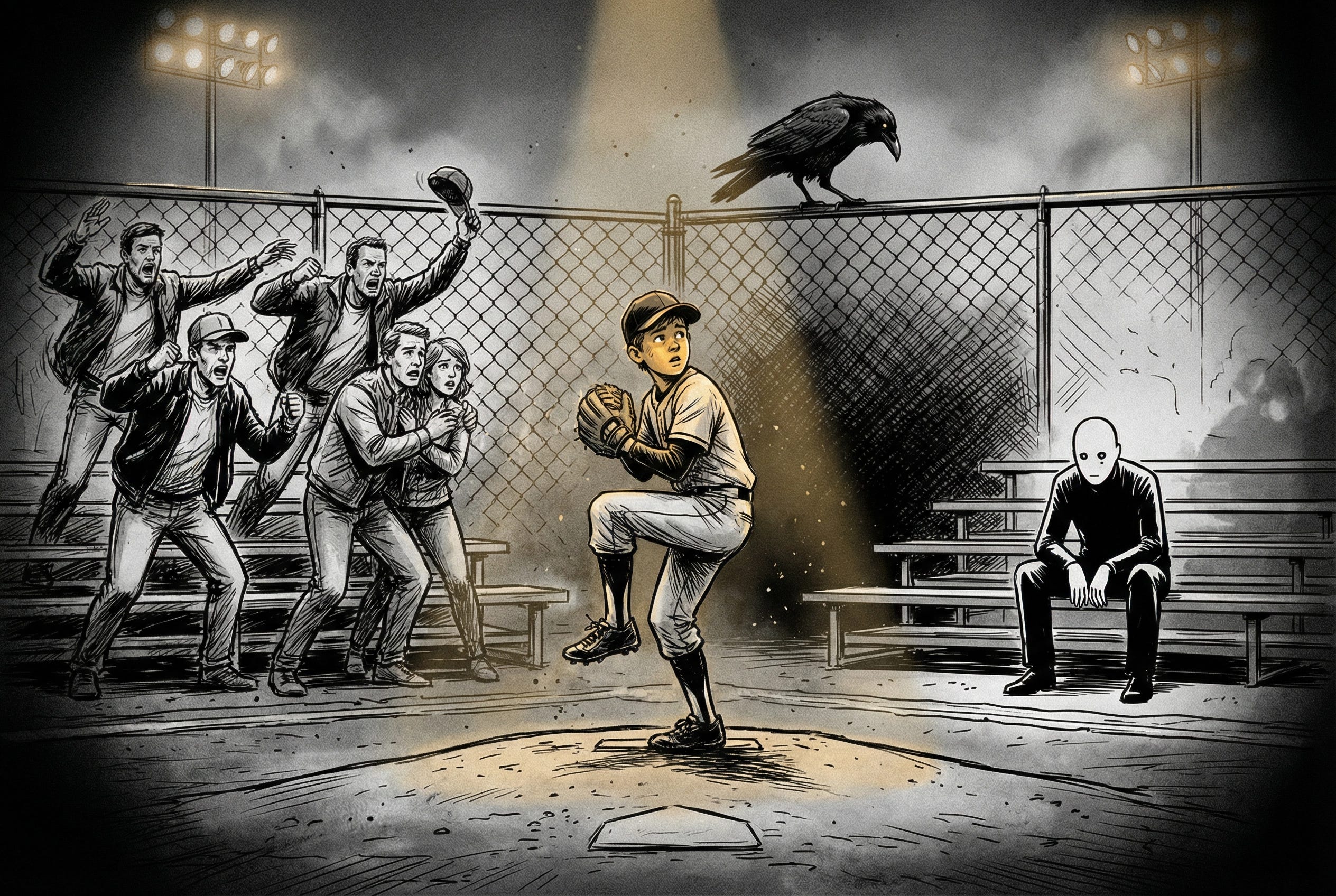
His boy is on the mound. Bottom of the sixth. Eleven years old. Bases loaded, and the kid’s glove hand is shaking, and the ball is slipping in his grip because his palm is wet, and he keeps wiping it on his pants, but it doesn’t help.
The other fathers are standing. Hands on the fence. Yelling things. Go get him, buddy. You got this. One man two rows up has his hat off and his knuckles white on the chain-link, and his voice is cracking, and the game doesn’t matter, it’s county league, nobody is getting a scholarship from this, but he is feeling something, and it is coming out of him because that’s what feeling does. It comes out.
Our man is sitting.
Same man. Same truck. Same flat eyes from Part 1, same phone in the pocket from Part 2. He is sitting on the aluminum bleacher with his forearms on his knees, and his face is even. Calm. His jaw is not tight. His hands are not fists. He looks like a man watching weather.
His boy looks over. Finds him in the stands.
The boy is looking for something in his father’s face. Not instruction. Not coaching. He wants to see that his dad is in this with him. That the moment is landing somewhere. That the man who made him is moved by what is happening to him.
The father nods. Once. Firm.
The boy turns back to the mound. He sets. He throws. The pitch sails high and wide, and the run scores, and the boy’s chin drops to his chest.
Every man in the bleachers exhales. Some groan. Some clap. Some holler encouragement. The man two rows up sits down hard, puts his hat back on, and says something to his wife, and she squeezes his arm.
Our man has not moved.
He will tell you later he was being steady. He will say a boy needs a father who doesn’t ride the highs and lows. He will say he was solid for his son. Rock. Anchor. The immovable thing.
His son will remember it differently. His son will remember looking into the stands for a heartbeat, only to find a wall.
He learned this young.
Not from a book. Not from a sermon on biblical manhood. From a kitchen. A living room. A hallway where the volume went up, and nobody came out better on the other side.
He watched a man feel things out loud, and it broke furniture. Or it broke his mother’s face. Or it broke the evening into before and after, and the after was always silent, and the silence was worse than the noise.
So he made a decision. Not with words. Boys don’t make decisions with words. He made it with his body. His jaw. His chest. Something closed, and it closed early, and it closed for good, and by fourteen, he could sit through anything without flinching.
They praised him for it.
Teachers. Coaches. His mother. You’re so mature. You’re so steady. You handle things so well.
He was not handling things. He was killing things. One feeling at a time. Quietly. The way you close doors in a house where someone is sleeping. He got so good at it he forgot the doors were there.
His wife knows.
She knew before they married. She mistook it for strength then. The man who didn’t panic. Didn’t yell. Didn’t crumble when her world got loud. She felt safe standing next to his silence.
Now she lives inside it.
She has asked him a thousand times how he feels. She stopped asking around year eight. Not because she stopped caring. Because the answer never changed. I’m fine. It’s fine. What do you want me to say?
That last one is the tell. What do you want me to say. Not a question. A surrender that sounds like irritation. He does not know what he feels. He has not known for so long that the not-knowing feels normal and the question feels like an ambush.
She has learned to read him the way you read weather. His silence after work means anger. His silence at the table means exhaustion. His silence in bed means he is somewhere far away, and she is not invited.
She is usually right.
She has stopped reaching for him at night. Not because she doesn’t want to. Because reaching for a man who is not there is worse than sleeping next to one.
His kids are fluent in him.
They know what he rewards. Toughness. Independence. Not needing him. A skinned knee gets a nod. Tears get a look. Not cruel. Not angry. Blank. The blankness is the lesson.
They perform this for him. His daughter fell at the playground last spring, stood up, brushed the gravel off, and walked to the car without a word. She is seven. She looked at him sideways to see if he noticed. He did. He said, Tough kid.
She is not tough. She is his student.
His son does not come to him when he is afraid. He goes to his mother. Our man has noticed this. He tells himself it’s natural. Boys go to their mothers at that age. It is natural. He made it that way.
A child does not stop bringing pain to a parent because the pain stopped. A child stops because the parent stopped receiving it.
Two words. The shortest verse in the English Bible and the one that should end every conversation about what it means to be a man of God.
Lazarus was dead. Jesus knew He was about to raise him. He knew the ending. He wept anyway. Not because He was confused. Not because He had lost control. Because the moment demanded grief, and He gave it.
He did not manage the moment. He entered it.
Be ye angry, and sin not: let not the sun go down upon your wrath.— Ephesians 4:26
Read that again. Be ye angry. That is a command that assumes you feel the anger. That assumes it is in you, alive, accounted for. The instruction is not suppress the anger. The instruction is feel it and do not sin with it. There is a canyon between those two things.
Suppression is not in the text. Not once. Not anywhere. What is in the text is David tearing his clothes. Paul weeping over churches. The Psalms are a man screaming at God in the dark, and God calling it worship.
The man who feels nothing is not the man of Psalm 42. The man who feels nothing is the man of Revelation 3. Neither cold nor hot. Lukewarm. The one God spits from His mouth.
He tells himself the stoicism is for his family. He is the rock. The anchor. The one who holds it together so everyone else can fall apart.
It is not for his family.
It is for him.
If he feels he has to be known. If he is known, he can be hurt. If he can be hurt, he is not in control. And control is the last thing he has that no one can take from him. He gave up joy to keep it. He gave up grief. He gave up the full range of being alive inside his own body and replaced it with a flat line, and called the flat line peace.
The stoicism is not protecting his wife from his chaos. His wife would take the chaos. She has begged for it. She would rather have a man who yells than a man who is not there. She told him this once, in the kitchen, and he stood very still and said nothing, and she walked out of the room, and they have never spoken of it again.
His silence is not strength. It is the most respected alibi of all. Because no one confronts it. No one says, Your coldness is destroying this house. They say, He’s steady. They say, He’s solid. They say, He’s the strong and silent type, and they mean it as praise, and he receives it as permission.
Permission to stay dead inside and call it duty.
There is a moment coming. He does not know when. A hospital room. A funeral. A night, his daughter calls him from a parking lot somewhere, shaking, needing her father.
The moment will require something from him that management cannot produce.
It will require presence. The kind that costs. The kind that bleeds. The kind his body has been trained to refuse since he was a boy watching a man break things in a kitchen and deciding, I will never be that. He was right. He is not that man. But the opposite of destruction is not numbness. The opposite of destruction is a man who feels the full weight of the room and stays in it anyway. Open hands. Wet eyes. Still there.
That is what David did.
That is what Jesus did.
That is what the strong and silent type has never once done.
His boy struck out. Three pitches later, the inning was over.
The boy walked off the field with his glove under his arm, his cap low, and his eyes on the ground. He passed his father on the way to the car.
The father put his hand on the back of the boy’s neck. Brief. Firm. The way men touch when they don’t know how to touch.
The boy did not look up.
There was a man two rows up holding his own son against his chest. The boy was crying. The man was letting him. His hand on the back of his son’s head, his mouth near the boy’s ear, saying something no one else could hear.
Our man saw this. He saw all of it.
He picked up his keys. He walked to the truck.
He sat there a while. Engine off. Hands on the wheel. He felt something move behind the wall, low and old, the way water moves under rock. He felt it press. He let it press. He did not open the door.
Not yet.