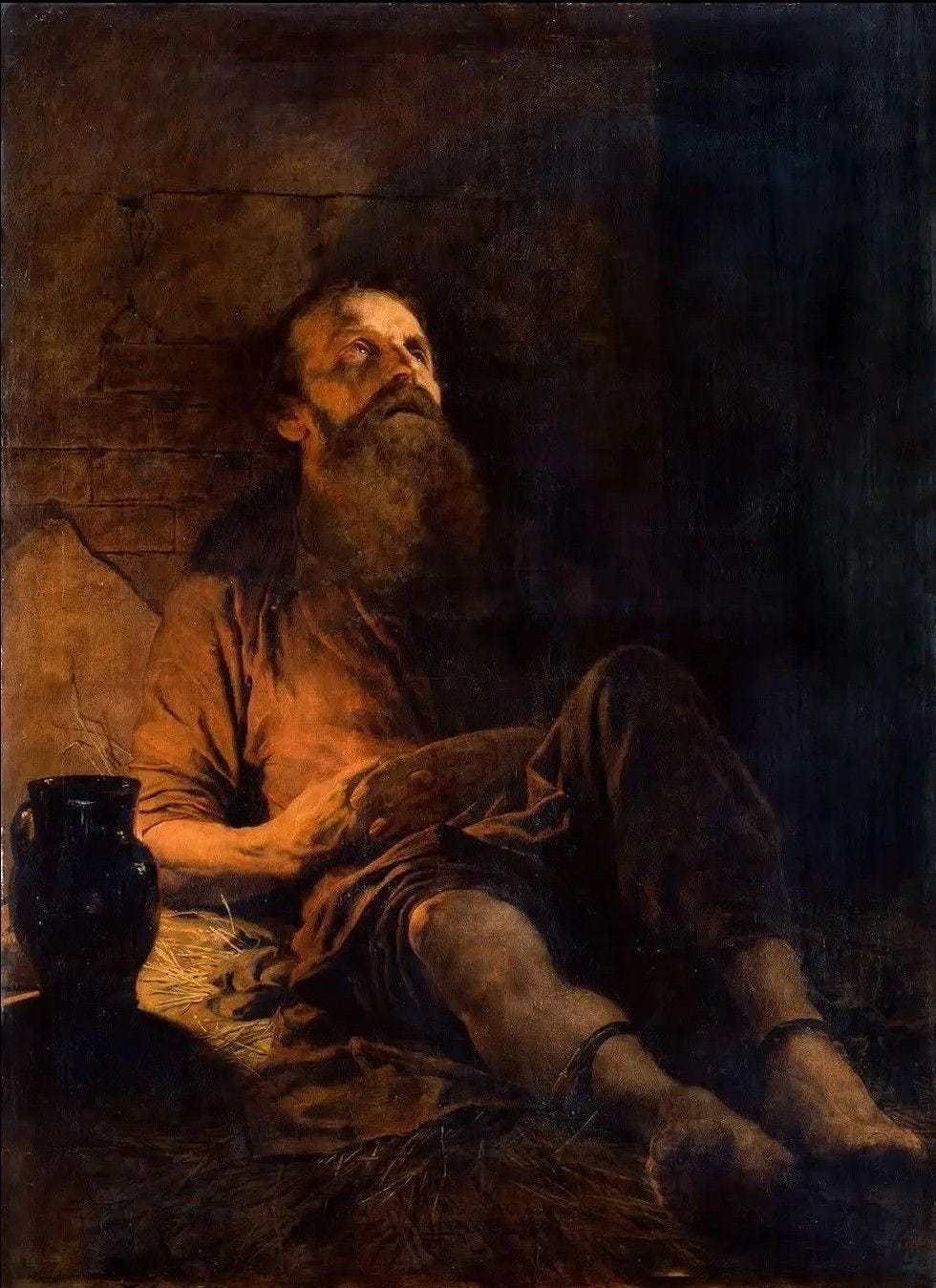
The Good Man's Alibi — Part 2 of 4
He is still in the truck.
Same man from last time. Coffee cold. Daughter asleep in her shoes on the couch inside, still in her jacket, still holding the thing she wanted to show him when he got home. He saw her through the window. He knows she’s there.
He is not ready.
So he sits. He opens the phone. He doesn’t look at anything in particular. He scrolls. He checks scores. He reads something he won’t remember in four minutes. He does this until some pressure in his chest subsides enough that he can walk through that door and perform the version of himself that the inside of that house requires.
This is not a dramatic sin.
This is Tuesday.
Good men don’t usually have spectacular falls. They have small ones. The kind that run so quietly in the background they’ve stopped registering as anything at all.
The phone. Not pornography. Just the phone. The reflex that fires the moment a conversation turns toward something real. The scroll that costs him nothing in the moment and everything over twenty years.
The two beers. Not alcoholism — he could stop, he tells himself, and maybe he’s right. But they show up like clockwork, right after the kids get loud and before his wife tries to talk to him about something that matters. They are not a vice. They are a schedule.
The garage. The shed. The hour in the workshop. The family has agreed not to call it hiding. They call it his space. He calls it his space. And it is his space — that’s true. It’s also a door that only opens from the inside.
The fantasy. Not the sexual kind, necessarily. The other one. The alternate life he runs in his head when this one gets heavy. Different job. Different city. Different version of himself who didn’t make the choices that made him who he is. He would never leave. He is very clear on that. But he visits, often, and stays a while.
The late-night thing. The food, the drink, the show, the screen. The thing he only does alone, when the house is quiet, when there is no one to perform for. The hour that belongs to no one. The one he guards more fiercely than he realizes.
None of these are catastrophic. That is precisely why they survive.
A man can confess adultery. He cannot confess that he sits in his truck for twenty minutes before coming inside because the thought of being needed, right now, without a buffer, is more than he can hold.
The first one sounds like a sin.
The second one sounds like a quirk.
But the second one is what builds the wall. Brick by brick. Twenty minutes at a time. A small daily retreat from the room where he is actually required. A managed distance between himself and the people trying to reach him. Eventually, the people stop trying as hard. Eventually, the distance becomes the relationship. Eventually, he looks up and wonders why everyone in his house is a stranger who is polite to him.
He never meant for it to go that far.
He never does.
His own iniquities shall take the man himself, and he shall be holden with the cords of his sins. — Proverbs 5:22
Not chains. Cords. That is the word. Chains you feel. Cords you don’t notice until you try to move.
The habit is not the thing. The habit is the relief valve for the thing. And the thing is the same thing under every alibi in Part 1: a man who cannot sit still in a room with himself. Who cannot be present without something running in the background, taking the edge off, filling the silence before it has a chance to ask him anything.
Let us lay aside every weight, and the sin which doth so easily beset us. — Hebrews 12:1
Easily beset. Not the dramatic sin. Not the one you’d confess at a men’s retreat with tears running down your face. The one that wraps around you without announcement. The one that is just sort of there, that has always been there, that you have negotiated a quiet truce with.
You are not enslaved to it. You just always do it.
Then when lust hath conceived, it bringeth forth sin: and sin, when it is finished, bringeth forth death. — James 1:15
It starts small. It finishes somewhere.
The question is not whether the habit is bad enough to count.
The question is what you are using it to avoid.
Not the phone. What the phone is standing in for. Not the two beers. What the two beers are managing. Not the garage. What the garage is making it possible not to face.
Because if the habit is a relief valve, something is building pressure. And a man who is always managing the pressure is never actually dealing with what’s pressurized. He is just keeping the gauge from going red. He is maintaining. He is fine. He is always, always fine.
His daughter woke up at some point. She took off her shoes herself and went to bed.
He came inside. He was kind. He did the dishes. He was present, after a fashion, for the rest of the night.
Nobody would say he was absent.
That is the alibi.
Parts 3 and 4 are coming soon.
Part 3: “The Strong and Silent Type” — the stoicism that is not strength but refusal. The man who has mistaken the suppression of feeling for the mastery of it.
Part 4: “The Blessing He Never Received” — what happens when a man spends his whole life trying to earn an approval that was never actually withheld from him.
If this one found you, pass it to a man who’s been sitting in his truck longer than he should.
WANT EVERYTHING?
THE BIBLICAL MAN VAULT
76 resources. Every guide, manual, and protocol. One price. $365
CLAIM THE FULL ARSENAL →