This afternoon I was out in my flower beds pulling weeds.
The kind that seem to appear overnight after one good rain.
At first glance they looked simple enough.
A few green leaves poking up through the mulch.
Easy. Quick. Nothing serious.
But when I bent down and started pulling, some of them would snap off in my hand almost immediately.
The top came away cleanly enough, but the root remained buried deep in the soil.
So I had to dig.
Push my fingers farther down into the dirt.
Loosen the earth around it carefully.
Follow the root lower than I first expected.
Any gardener knows this lesson.
If you do not get to the root, the weed is coming back.
Maybe not tomorrow.
Maybe not next week.
But it will return.
Pushing itself back through the surface, prickly and ugly as before.
And while I worked, I thought about this series I’m writing on families.
And—I realized how quietly we can lose the people we love when we never learn how to deal honestly with hurt.
Conflict is part of life.
There is no way around it.
If you have people in your home, there will be conflict.
A home with two people will have conflict.
A home with ten people will have conflict.
Wherever human beings gather together long enough, selfishness, misunderstanding, pride, exhaustion, sharp words, unmet expectations, and wounds will eventually appear.
The issue is not whether conflict exists.
The issue is whether anyone knows how to handle it in a healthy and godly way.
Scripture says, “Only by pride cometh contention.” Proverbs 13:10
That verse is painfully simple.
Only by pride.
At the root of conflict, somewhere buried beneath the details, pride is always crouching.
Sometimes it is obvious pride.
Sometimes it hides itself better.
Pride can look like defensiveness.
It can look like stubborn silence.
It can look like manipulation.
It can look like the desperate need to be right.
It can look like refusing correction.
It can look like the inability to say, “I was wrong.”
And families suffer deeply when no one is willing to dig down to the root.
Many homes live by what I think of as the broom-and-rug method.
Something painful happens.
Words are spoken.
Trust is bruised.
Feelings are wounded.
Everyone feels the dirt sitting there in the middle of the room.
But instead of dealing honestly with it, someone grabs a broom, sweeps the mess under the rug, smooths the corner back down, and carries on pretending the room is clean.
The problem is, the dirt never left.
It is still there underneath.
And after enough years, the hidden dirt begins to show through the top side of the rug too.
The atmosphere changes.
The room feels heavy.
Bitterness begins shaping the tone of conversations.
Family members become guarded.
Old hurts quietly attach themselves to new disagreements.
People start reacting not only to what was just said, but to ten years of unresolved pain buried beneath it.
Hebrews warns us about “any root of bitterness springing up trouble you, and thereby many be defiled.” Hebrews 12:15
Many.
One bitter root can affect a whole family.
Children grow up breathing the air of unresolved conflict even when no one speaks openly about it.
A wife begins hardening inwardly.
A husband withdraws emotionally.
Siblings learn sarcasm instead of honesty.
Everyone adapts around the dysfunction instead of healing it.
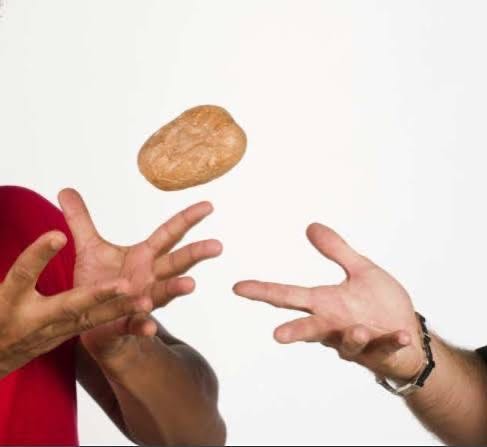
Then there is the blame-shifting method.
The old hot potato game.
No one wants to hold responsibility, so everyone keeps tossing it to someone else.
“Well, I only reacted because you…”
“If you hadn’t…”
“You always…”
“Your tone made me…”
The hurt keeps getting passed around the room, but no one actually stops long enough to own their part in the wound.
The person who was injured often walks away carrying the whole cold weight of it while everyone else explains why they should not have to repent.
That method poisons families too.
Healing cannot happen where ownership never happens.
A healthy family does not require perfect people.
Thank God for that, because none of us would qualify.
But it does require humble people.
Teachable people.
Repentant people.
People willing to look at their own flesh before dissecting everyone else’s failures.
Jesus said in Matthew 7, “First cast out the beam out of thine own eye.”
First.
Not eventually.
Not after proving your case.
First.
That alone would change many homes.
If husbands approached conflict asking, “Lord, show me my own pride first.”
If wives approached conflict asking, “Father, where was my flesh ruling here?”
If parents approached children with humility instead of only authority.
If children learned early that repentance is not humiliation.
Matthew 18 gives us the pattern for dealing with conflict among believers.
“If thy brother shall trespass against thee, go and tell him his fault between thee and him alone.”
Go to the person alone.
Speak honestly.
Handle it directly.
Do not recruit team members first.
Do not build a case in secret.
Do not gossip under the disguise of concern.
Go to the person.
Families desperately need this kind of honesty.
Not brutal honesty meant to wound.
Not emotional dumping.
Honest, humble confrontation rooted in love and the spirit of reconciliation.
There are families who have not spoken truthfully in years.
They speak in hints.
In sarcasm.
In passive aggression.
In sighs.
In coldness.
In awkward silence.
Everyone knows something is wrong, but no one wants to be the first one vulnerable enough to say it plainly.
That silence slowly eats the family alive.
If there are deep issues already in your family, do not lose heart reading this.
Some roots have grown for decades.
Digging them out will take time.
There may need to be confession.
Counseling.
Difficult conversations.
Boundaries.
Tears.
Patience.
Forgiveness practiced repeatedly instead of spoken once quickly and forgotten.
But healing is still possible.
A family culture can change.
A marriage can relearn honesty.
Parents can apologize to children.
Adult children can begin dealing truthfully with old wounds instead of only carrying resentment.
Siblings can stop pretending.
The Lord is able to bring life back into places long neglected.
And perhaps some reading this came from homes where healthy conflict simply did not exist.
Maybe everything was explosive.
Maybe everything was buried.
Maybe no one modeled repentance.
Maybe pride ruled every room and vulnerability felt dangerous.
That history matters.
But it does not have to become inheritance.
By God’s grace, it can end with you.
You can become the husband who says, “I was wrong.”
You can become the wife who does not weaponize silence.
You can become the parent who disciplines without shaming.
You can become the family that tells the truth, forgives sincerely, and refuses to let bitterness grow wild in the garden.
Roots can be pulled up.
The process is messy. Soil gets disturbed. Hands get dirty. Sometimes the root is deeper than anyone realized.
But if the root finally comes out, there is room for something beautiful to grow in its place.
Dig up those roots, learn how to handle conflict in a Biblical and healthy way—don’t quietly lose your family over unresolved conflict.
Biblical Womanhood
My newest booklet “Feminine Needs, Wants, & Flaws” is now live! This is still a “fundraiser style” purchase for our family. The booklet is set at a preferred $10 minimum but the amount can be changed up or down. Order here: