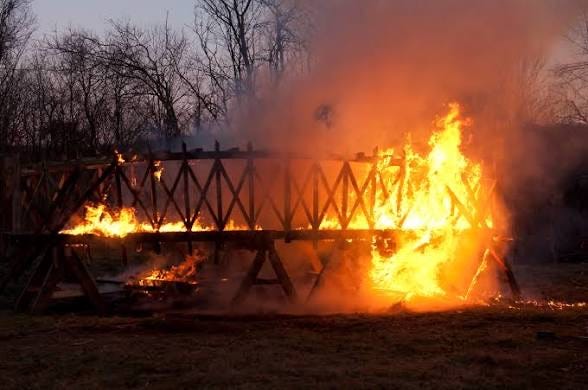
“There's no fall greater than one from a burnt bridge" --C. Wallace
People in their carnal state seem far more likely to set relationships on fire than to repair them.
A disagreement surfaces.
Pride quietly stiffens the heart.
Words are spoken too quickly and heard through old hurts.
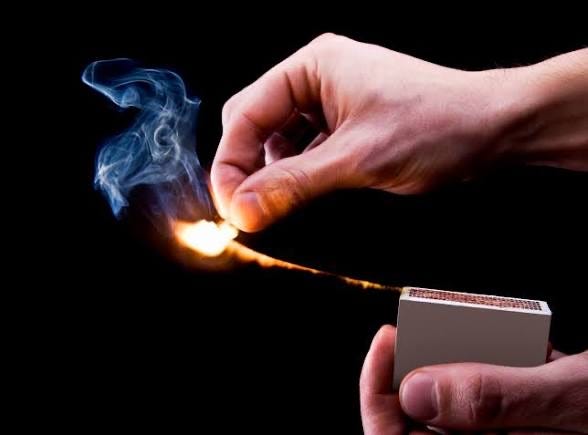
And instead of slowing down long enough to pray, listen, seek understanding, and labor toward reconciliation, someone reaches for a match.
And once a match is lit, it does not take long for years of relationship to go up in flames.
The world glamorizes burned bridges as though relational destruction were some kind of courage.
People speak proudly now about “cutting people off,” “protecting their peace,” and walking away from anyone who becomes difficult, uncomfortable, or disappointing.
Entire social media cultures have formed around the celebration of severed relationships, framing isolation as empowerment and estrangement as strength.
But many of these scorched-earth exits are not born from wisdom or genuine necessity.
They are born from pride, impatience, unforgiveness, and an unwillingness to labor through the hard, sanctifying work of reconciliation.
A bridge reduced to ashes may feel powerful in the heat of anger, but eventually many people find themselves standing alone on an island they built with their own hands.
Scripture gives Christians a far different command than the one modern culture rewards.
We are told plainly that God desires we have the ministry and word of reconciliation here in 2 Corinthians 5:18-19 KJV :
“And all things are of God, who hath reconciled us to himself by Jesus Christ, and hath given to us the ministry of reconciliation;
To wit, that God was in Christ, reconciling the world unto himself, not imputing their trespasses unto them; and hath committed unto us the word of reconciliation.”
Reconciliation is the labor of bringing estranged things back together.
It is the work of repairing what has been fractured.
It requires humility, confession, forgiveness, patience, and a willingness to endure discomfort for the sake of restoration.
The flesh rarely wants that kind of work.
The flesh wants distance.
The flesh wants vindication.
The flesh wants to gather evidence proving why the other person is more wrong.
The flesh wants to protect pride instead of preserve relationship.
And because pride sits so close to the center of human conflict, many relationships die not from one catastrophic wound, but from two people refusing to bend low enough to heal.
I have watched friendships quietly burn this way.
Two women who once prayed together, laughed together, carried one another’s burdens, sat at one another’s tables, and knew each other’s children deeply suddenly find themselves wounded by misunderstanding, hurt feelings, or careless words. Instead of working through the conflict carefully, the bridge is set on fire.
Texts stop.
Invitations stop.
Silence settles in.
And eventually both women begin speaking of one another as though years of shared life never existed at all.
This grieves me.
Because conflict is part of every close relationship.
There are no friendships untouched by misunderstanding.
Human beings are imperfect.
We say things poorly.
We hear things through our own wounds sometimes.
We fail one another.
A friendship worth having is usually worth fighting through some adversity to keep.
“Endeavouring to keep the unity of the Spirit in the bond of peace.” Ephesians 4:3
Endeavouring.
That word implies effort.
Unity rarely maintains itself naturally.
It must be guarded.
Humility must protect it.
Pride must be put to death for it.
Church families suffer deeply from this same spirit.
Some people leave churches the moment tension appears.
One disagreement.
One hurt feeling.
One awkward conversation.
One unmet expectation.
One conviction from the pulpit that rubbed against pride.
A match is struck, and the bridge burns behind them as they walk away.
Then the pattern repeats somewhere else.
Because every church is filled with sinners still being sanctified.
There are certainly times when leaving a church is necessary.
If doctrinal truth is being abandoned, if leadership becomes abusive or corrupt, if Scripture is no longer held rightly, those are serious matters.
I am not speaking about those situations.
Nor am I speaking of abuse within family relationships where safety and wise boundaries are necessary.
I am speaking about ordinary conflict.
The sort of conflict every human relationship eventually encounters.
The problem is that some families never learn how to endure discomfort long enough to work toward healing.
They move constantly.
Relationship to relationship.
Church to church.
Friendship to friendship.
Everywhere they go, there is eventually another burned bridge behind them.
And children grow up watching this.
They learn that relationships are disposable.
They learn that disagreement means departure.
They learn that loyalty lasts only as long as everyone remains comfortable.
They learn that conflict is something escaped rather than worked through with prayer, truth, repentance, and grace.
That lesson follows people into adulthood.
The same thing happens within extended families.
Adult siblings stop speaking.
Cousins grow distant.
Parents and grown children become estranged.
Small offenses are left sitting untouched until bitterness grows around them like ivy over stone.
Eventually someone lights a match with harsh words, gossip, pride, or retaliation, and the whole relationship catches fire.
The tragedy is that many of these relationships could have been healed years earlier if someone had been willing to humble themselves before the Lord.
“Only by pride cometh contention.” Proverbs 13:10
Pride keeps people from apologizing.
Pride keeps people rehearsing offenses instead of releasing them.
Pride whispers that reconciliation would somehow diminish us.
Pride convinces people that protecting ego matters more than preserving relationship.
And the enemy delights in every burned bridge.
Because isolation weakens people.
Fragmented families weaken communities.
Church division weakens testimony.
Bitterness poisons homes.
Children raised among ashes often carry the smell of smoke into every future relationship they build.
God’s Word calls us toward another way.
“If it be possible, as much as lieth in you, live peaceably with all men.” Romans 12:18
Notice the tenderness and realism there.
If it be possible.
As much as lieth in you.
Scripture recognizes that reconciliation sometimes requires willingness from both sides.
You cannot force another person into peace.
But you are still responsible before God for your own spirit, your own humility, your own willingness to pursue healing where it can be pursued.
And that pursuit matters deeply.
Sometimes reconciliation begins with one honest conversation instead of ten private conversations with everyone else.
Sometimes it begins with saying, “I handled that poorly.”
Sometimes it begins with asking questions before assuming motives.
Sometimes it begins with sitting quietly long enough to actually hear the hurt underneath someone’s anger.
Sometimes it begins with refusing to strike the match, even when your flesh badly wants the fire.
The Christian life requires an entirely different posture toward relationships than what modern culture encourages.
We are not called to collect offenses like trophies.
We are not called to keep emotional scorecards.
We are not called to sever every relationship the moment it becomes difficult.
We are called to forgiveness.
We are called to longsuffering.
We are called to bearing and forbearing one another.
“Forgiving one another, if any man have a quarrel against any.” Colossians 3:13
Any.
That verse leaves little room for our pride to hide.
And perhaps some reading this come from families where no one knew how to handle conflict rightly.
Maybe every disagreement became a wildfire.
Maybe silence ruled the home.
Maybe relationships were constantly breaking apart around you.
Maybe you learned early that love felt fragile and temporary.
But by God’s grace, patterns can end.
You can build a different kind of family.
A family where apologies happen.
A family where truth is spoken gently.
A family where conflict is addressed instead of buried.
A family where forgiveness is practiced sincerely.
A family where bridges are repaired instead of burned at the first sign of difficulty.
That kind of family does not happen accidentally.
It is built slowly through humility, repentance, and the grace of God working in imperfect people who decide relationships matter enough to fight for.
Remember….
The enemy loves ashes.
Christ loves reconciliation.
Biblical Womanhood
Please hit the ♥️, comment, or share if you enjoyed this post! This helps keep my content visible to others who may be searching!
If Biblical Womanhood has encouraged your walk, strengthened your home, sharpened your thinking, or helped steady your heart in this confused age, consider becoming a paid subscriber and helping support this ministry.
Founding Members receive every digital product I release throughout 2026 included with their membership.
Bible studies, devotionals, booklets, teaching series, and future resources will all be delivered directly to you as part of that support.
This little corner of the internet exists because readers chose to stand behind it.
I’m deeply grateful for every one of you who reads, prays, shares, gives, and helps keep this work going forward.