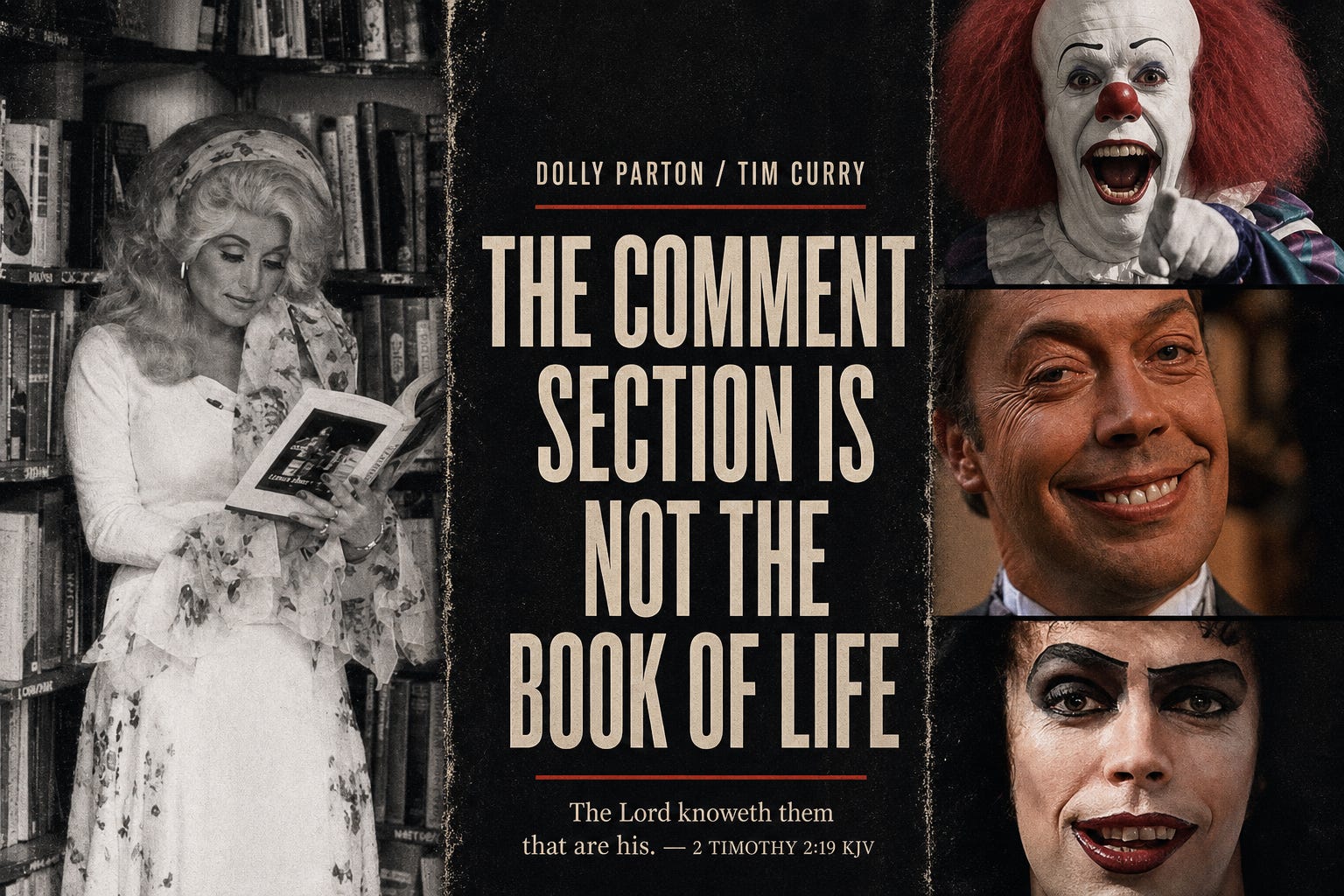
Dolly Parton died in a cancer center in Nashville.
Tim Curry died at home in Los Angeles.
Same Tuesday. August 25, 2026.
Same age. Eighty.
One left rhinestones, gospel records, songs, and books in children’s hands.
The other left greasepaint, fishnets, a killer clown, and a hundred strange voices.
Then came the verdicts.
Of course they did.
Under Curry’s memorial, strangers wrote that he and Dolly were walking through the pearly gates together.
One Christian content creator called Dolly’s testimony “wicked”.
When a critic objected, the answer came back:
“Dude, are you even saved?!”
Affection handed Curry a halo.
Suspicion built Dolly a courtroom.
Neither crowd had seen the record.
Curry’s obituary carried Pennywise, Frank-N-Furter, and that grinning hotel concierge. Those were characters. In his 2025 memoir, Vagabond, he warned readers not to confuse the man with them.
The new American funeral
Death used to leave a room quiet.
Now it fills a comment box.
The obituary is still fresh. The coffee is still hot. The thumb is already moving.
Verdict ready.
Social-media Christians see a fresh death and reach for a gavel. They do not grieve. They audit. They do not warn the living. They prosecute the dead.
Then they call it discernment.
Often it is vanity with a Bible avatar.
The appetite is not only theirs.
It lives in us.
A verdict feels cleaner than grief. Certainty feels strong. Humility feels weak.
That’s you. That’s me.
We want every file closed before night. We want the famous Christian safely upstairs. We want the famous sinner safely downstairs. We want the universe labeled before the next notification arrives.
God did not hand us that job.
Public evidence matters
Dolly left a public record of faith.
That matters.
She called herself a person of faith. She prayed. She recorded gospel music. She spoke about seeing her husband again. Her family said she was in the arms of Jesus.
Those are facts.
Tim Curry left another public record.
That matters too.
His father was a Methodist chaplain. Curry sang in church as a boy. In a 2005 Fresh Air interview, he called himself a cheerful agnostic.
Those are facts too.
Words matter. Profession matters. Fruit matters.
But evidence is not omniscience.
A public record is not a soul. An old interview is not the final hour. A gospel album is not the blood of Christ. Neither is an agnostic quote stronger than Christ.
You may repeat what somebody said.
You may name unbelief.
You may warn the living.
You may preach Christ without apology.
You may not sign God’s name beneath your verdict.
Paul drew the line without softening either side:
“Nevertheless the foundation of God standeth sure, having this seal, The Lord knoweth them that are his. And, Let every one that nameth the name of Christ depart from iniquity.”
2 Timothy 2:19
Both halves matter.
The first breaks our gavel.
The Lord knows his own.
The second breaks cheap sentiment.
Anyone naming Christ must depart from iniquity.
The verse gives us no permission to call rebellion faith. It gives us no permission to call our suspicion omniscience.
No mush. No celebrity worship. No pretend certainty.
The electric chair test
Ted Bundy exposed this problem decades ago.
This is not a comparison of their lives. It is a test of our doctrine.
Hours before the electric chair, James Dobson asked Bundy about a claimed profession of Christ. Dobson said Bundy had told him he accepted the forgiveness of Jesus Christ. Bundy said he drew strength from it.
Christians split.
Some announced heaven.
Others called it one last con.
There was reason for doubt. Bundy had spent years lying and manipulating. There was also a spoken profession. Dobson himself did not claim to know whether it was genuine.
That was honest.
Nothing about salvation erased the murdered women and girls. Nothing canceled their families’ grief. Nothing canceled the sentence Florida carried out.
Grace does not call evil harmless.
It calls Christ sufficient.
God can save a murderer near the edge of death. A murderer can also lie near the edge of death. The camera cannot settle that question.
The Lord knoweth them that are his.
If grace cannot reach the worst sinner, it is not grace. If one religious sentence automatically proves conversion, it is not discernment.
Social-media Christians hate that tension. They want a clean docket. They want heaven populated by people they like. They want hell populated by people who disgust them.
That is not the gospel.
That is a private club with clouds painted on the ceiling.
Your children are listening
Your children learn theology from your tone.
They hear you preach salvation by grace. Then they watch you demand a polished religious résumé from the dead.
They notice.
They watch you excuse sin because a celebrity was kind. They watch you condemn a soul because an actor wore a costume.
They notice that too.
One lie makes holiness optional.
The other makes grace impossible.
Teach them the narrow truth.
Human love cannot save us. Human disgust cannot damn us. We are sinners. Christ saves. Christ judges. Christ knows.
No comment section appears in that chain.
Close the app
If Dolly Parton is with Christ, it is not because millions loved her.
If Tim Curry died without Christ, it is not because millions saw him in fishnets.
If Ted Bundy received mercy, it is not because a camera caught him saying Christian words.
Popularity cannot save.
Disgust cannot damn.
A résumé cannot wash sin.
A costume cannot tell us whether a man died in Christ.
At the grave, rhinestones and greasepaint are both costumes.
The awards stay here. The money stays here. The songs keep playing. The body does not.
Mourn what was beautiful.
Name what was false.
Tell the living the gospel.
Leave the dead with the Judge who cannot be fooled.
The comment section is not the Book of Life.
Close the app.
Open the Book.
Adam
If you want Bible-first writing that refuses both sentimental lies and self-righteous verdicts, subscribe to The Biblical Man.
The Bible, made plain. Marriage. Family. Work. Repentance. Provision. The home.
Subscribe to The Biblical Man