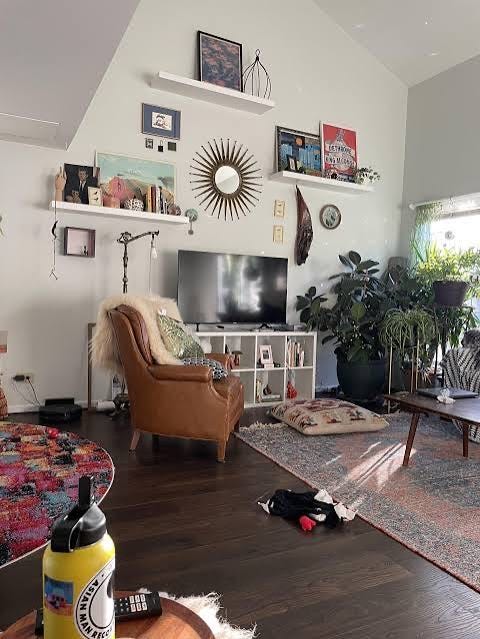
When I think back over 24 years of raising children, some of the scenes that stay with me are so ordinary I doubt I recognized their importance while they were happening.
Somebody was stretched across the couch with a book, somebody else was sitting on the floor, a child wandered in needing to tell me something that apparently could not wait another thirty seconds, and the television or the radio may or may not have been on in the background while the rest of us were simply living.
That is what makes the living room so important as I finish this series.
The kitchen has a fairly obvious purpose.
We feed people there.
The bedroom carries an intimacy that belongs particularly to husband and wife.
The living room is harder to define because it becomes whatever the family repeatedly does inside it, and perhaps for that reason it reveals more about the actual life of a home than we realize.
This is the room where we dwell.
It is where the family lands after work and school, where children watch their parents interact when nobody is trying to make a lesson out of anything, where entertainment comes into the house, where conversations wander, where arguments sometimes happen, where apologies should happen too, and where hundreds of ordinary evenings gradually teach children what kind of people their parents really are.
Deuteronomy 6:6-7 says, “And these words, which I command thee this day, shall be in thine heart: And thou shalt teach them diligently unto thy children, and shalt talk of them when thou sittest in thine house, and when thou walkest by the way, and when thou liest down, and when thou risest up.”
I love that God places teaching children right in the middle of our everyday ordinary life.
“When thou sittest in thine house.”
That sounds a great deal like the living room to me.
We can spend years worrying about whether our children are receiving enough formal instruction, and certainly there is a place for family devotions, Scripture memory, church, Sunday school, and deliberate teaching.
Still, much of what our children believe about Christianity will be formed while they are watching us live during the hours when no Bible lesson has been announced.
They hear what we preach on Sunday.
Then they watch what happens on Tuesday evening.
They know whether grace is something we speak about at church and practice poorly at home.
They know whether Dad treats Mom with the same respect in the living room that he expects everyone else to show him.
They know whether Mom’s Christianity makes her kinder as the years pass, whether forgiveness actually happens after somebody sins, and whether prayer is something we reach for only during emergencies or something woven naturally into family life.
Children live close enough to us that performance becomes very difficult to maintain.
Eventually they see the real thing.
That convicts me because there have certainly been days when what my children saw in me did not line up very well with what I would have wanted to teach them.
They have seen irritation, impatience, worry, and reactions I wish I could take back.
Anyone who has raised children for very long and claims otherwise has either forgotten a great deal or had a very different experience than I did.
Our children do not require the performance of flawless Christianity.
They do need to see what Christianity does with failure.
If I speak harshly, do I eventually humble myself enough to say I was wrong?
If I become consumed with worry, do they ever see me bring that worry back under the truth I claim to believe?
If my husband and I disagree, does the atmosphere of the house become tense for three days while everybody learns to navigate around us, or do our children eventually see two imperfect people work their way back toward one another?
Those are lessons too.
The living room also forces us to think about what we allow to shape the spirit of the home because, in many houses now, the largest object in that room is a screen.
I am not anti-television.
I enjoy watching things, and I am not interested in pretending technology itself is the great villain of modern family life.
We have used screens in moderation for entertainment, education, laughter, and plenty of ordinary evenings when everyone wanted to sit down and watch something together.
Still, I think we should occasionally ask whether the screen has become the presiding presence in the room.
What does it get to say?
What do we allow it to bring into our home because the story is interesting enough that we are willing to overlook everything attached to it?
Psalm 101:3 says, “I will set no wicked thing before mine eyes.”
That verse becomes very practical when you are sitting on a couch with a remote in your hand.
There are things Christians would never dream of inviting into their home personally while allowing them to play across a sixty-five-inch screen in front of their children because the culture has taught us to separate entertainment from influence.
We excuse language we would correct in our children.
We sit through sexual content we would be horrified to see acted out in the next room.
We consume storylines that treat adultery, fornication, drunkenness, rebellion, cruelty, and every form of ungodliness as ordinary enough that after a while our conscience barely registers what our eyes are watching.
Then we wonder why our children seem comfortable with things that once made us uncomfortable.
They have been watching us be comfortable with them.
That does not mean every story has to feature perfect people behaving perfectly, because the Bible itself contains some deeply sinful human behavior.
The question is what the story is asking us to approve, admire, laugh at, or normalize.
I have had moments where I realized I was making excuses for something simply because I wanted to keep watching it.
That is probably a good place for a Christian to stop and pay attention.
If I would be embarrassed for the Lord to sit beside me while something plays, perhaps the fact that I cannot physically see Him should not make the decision easier.
And then there is the smaller screen, which may be causing an even greater change in our living rooms.
You can now put an entire family on one couch and have nobody in the same place.
One person is scrolling social media, another is watching short videos with headphones in, somebody is texting, somebody else is gaming, and everyone is technically together while inhabiting completely separate worlds.
I have caught our family doing this, too.
You pick up the phone intending to answer one message, and twenty minutes later you realize the people in the room have been carrying on without you while you watched the lives of people who are not even there.
That should bother us.
There is something unnatural about being more aware of what a stranger posted from another state than of what is happening ten feet from us.
Our families need stretches of time where we are available enough to notice one another.
Children do not always announce an important conversation by saying, “Mother, I now need to discuss something formative with you.”
They wander in.
They sit nearby.
They start telling a story about something completely unimportant, and if you are paying attention, you may realize halfway through that the thing they really wanted to talk about is underneath the story.
Those moments are easy to miss when everybody’s face is turned toward a different screen.
The living room can become something close to a waiting room when a family loses the habit of being present with one another.
People come in, sit down, wait for bedtime, and entertain themselves until the evening is over.
I do not want that to be the defining rhythm of our home.
There should still be laughter that belongs to the people in the room rather than to something playing through speakers.
There should be conversations that are allowed to go nowhere in particular, children stretched across furniture, somebody reading, somebody telling a story, and enough boredom occasionally that a person has to look up and notice everyone else.
Boredom has probably been historically responsible for more family interaction than we give it credit for…today’s modern family has a serious lack in boredom.
What is that costing us?
Its important to remember that the living room is where so much ordinary family life plays out, it is also where our convictions become visible.
Joshua said, “as for me and my house, we will serve the LORD.” Joshua 24:15.
That is a beautiful verse to hang on a wall.
Eventually the people living under the verse need to see it practiced beneath the frame.
What does serving the Lord look like when someone hurts our feelings?
What does it look like when money is tight, when the news is frightening, when somebody at church disappoints us, when plans change, or when a child makes a decision that tests everything we thought we knew about parenting?
Our children learn what matters by watching what matters to us when life becomes inconvenient.
The living room becomes a sort of laboratory where the claims of our faith are tested against ordinary life.
That can feel exposing.
Maybe it should.
Because I do not want my children or grandchildren to grow up remembering that Christianity was something we dressed for every Sunday morning while the rest of the week was governed by the same appetites, entertainment, attitudes, and priorities as anybody else.
I want them to know there was something real in our home.
A home can drift.
The television gets used more because everyone is tired.
Phones begin living permanently in our hands. Family conversation thins out, and by the time we notice it, everyone has developed a routine that functions fairly efficiently without requiring much from anyone else.
That is how most family habits form, for better or worse.
We repeat something until it becomes normal.
And the good news about habits is that we can begin changing them the same way.
Maybe the television does not need to be on every evening.
Maybe everyone can put their phones away for an hour without experiencing any lasting damage.
Maybe there are things playing in our home that we need to stop excusing.
Maybe we need to sit in the same room and actually be available to one another again.
We do not have to turn family life into a program.
Sometimes the most meaningful change is simply creating enough space for real life to return.
That brings me back to Psalm 127:1, the verse that has been sitting underneath this entire series:
“Except the LORD build the house, they labour in vain that build it.”
The rooms themselves are ordinary.
A kitchen is still a kitchen.
A bedroom is still a bedroom.
A living room is ultimately furniture, walls, lamps, and whatever objects we have accumulated inside it.
The life built there is what lasts.
In the kitchen, we talked about nourishing a family through food, fellowship, hospitality, and the ordinary rhythm of gathering around a table.
In the bedroom, we considered the marriage underneath the family and the importance of protecting the affection, intimacy, and friendship that belong to husband and wife.
And now, in the living room, we come to the place where much of what we claim to value becomes visible simply because everybody is there long enough to watch.
This is where our children learn what matters.
They learn it from the things we permit, the habits we repeat, the way we treat each other, and the priorities that quietly govern our evenings.
Years from now, they may not remember the couch.
They probably will not remember which television we owned or whether the room ever looked as put together as we hoped.
But they may remember how it felt to live there.
I hope they remember a home where people looked up when somebody entered the room.
I hope they remember that laughter came from one another often enough that entertainment never completely replaced fellowship.
I hope they remember seeing a Christianity that had enough substance to survive Monday through Saturday.
And when they eventually build homes of their own, I hope something about ours makes them want the Lord in theirs.
Because the Christian home is built in these ordinary rooms, through ordinary days, by ordinary people who have to keep remembering who the house ultimately belongs to.
“Except the LORD build the house, they labour in vain that build it.”
May He build ours.
Biblical Womanhood
If you enjoy this post please ♥️, comment, or share—These simple gestures help share this message with others who may be encouraged and blessed by this ministry.
Pre-order is now open for a week long scriptural study on:
“The Art of Biblical Homemaking”
A home is more than a place to live. It is a place where faith is practiced, relationships are cultivated, character is formed, hospitality is extended, and the goodness of God can be made visible in ordinary life.
This study will help answer three main questions:
What does God say a home is meant to be?
What does Scripture teach about a woman's influence within her home?
How do we translate biblical principles into practical, everyday habits?
Rather than being another homemaking book filled with cleaning schedules and recipes, this is a study of the heart, habits, and spiritual purpose of homemaking, with practical applications that help you live out what you learn.
(This product will be finalized and emailed out by end of day Nov 1. Everyone who pre-orders this study will also receive a surprise free gift when the email goes out!)
“Practical Submission: A 10 Day Study on Applying Biblical Submission in your Daily Life”
Want to go deeper on the topic of Biblical Submission?
Each day begins with a realistic marriage situation, then walks through the Scripture, the heart issue underneath it, and what submission can actually look like in everyday life.
This is not theory or a list of vague principles. It deals with tone, decision-making, finances, parenting, disagreement, control, trust, and learning how to follow God’s order in the ordinary places where marriage is really lived.
If you’ve ever wondered what Ephesians 5:22 looks like on a Tuesday evening in a real home with two imperfect people, this study was written for you.
The Bitter Root: How Bitterness Destroys the Heart and Home
Over seven days, we look honestly at bitterness through a biblical scope and walk through practical, scriptural ways to keep your own heart tender before the Lord so that what grows in your house is grace instead of an old family wound.