Last week my kitchen slowly became a mess.
We had illness moving through the house, our grandbaby was unwell, we had special meetings going on at church with commitments that still needed to be kept, and I was one of the sick ones myself.
Somewhere in the middle of all of that, I lost whatever normal rhythm I usually have in the kitchen.
Meals became whatever required the least amount of thought, things piled up faster than I could get to them, and by the time I started feeling human again, the kitchen looked about like I felt.
I have kept a home long enough to know that a week like that is not some moral crisis.
Sometimes everybody gets sick and survival mode takes over for a few days.
Sometimes the grocery plan gets abandoned, the deeper cleaning waits, and supper comes through a drive-through window because nobody has the energy to make it any more complicated than that.
Still, as I began putting things back in order, I found myself thinking about how much life happens in this one room, and how easily we can forget what a kitchen is capable of becoming when we reduce it to the place where groceries are stored and food is heated.
That thought is what started this little series for me.
There are three rooms in a Christian home that I want to spend some time thinking about this week:
The kitchen: where fellowship is built
The bedroom: where marriage is protected
The living room: where children learn what matters
Obviously a family lives in every room of the house, and I am not trying to assign some mystical spiritual meaning to countertops and couches.
I am thinking more about what these rooms have represented in family life for generations, and what can disappear when we stop being intentional about how we use them.
Psalm 127:1 says, “Except the LORD build the house, they labour in vain that build it.”
I have read that verse many times, but lately there is something that makes the word build feel less abstract.
A home really is built.
It is built through habits repeated until nobody has to announce them anymore.
It is built through meals and conversations, through who is welcomed through the door, through what children hear their parents discussing, through what happens when somebody is hurting, and through thousands of ordinary evenings that nobody will remember individually even though together they become childhood.
That makes me think differently about the American dream.
We can work for years to get the house we wanted, fill it with all the things we hoped to have, give everyone their own room, their own screen, their own schedule, their own preferences, and somehow end up all alone together inside the house of our American dreams.
Everybody is home, technically.
Nobody is really together.
Modern life makes that incredibly easy because almost everything can be individualized now.
Everybody can eat something different at a different time while watching something different on a different device, and the family can pass through the same kitchen all evening without ever sitting down long enough to have a conversation.
I do not want that to become normal without putting up a fight.
The kitchen has always felt like the heart of the home to me because so much of the ordinary care of a family passes through it, and maybe one of the simplest questions a mother can ask herself is, “What am I cooking up in the heart of my home?”
Part of that question is very literal.
Our families have bodies, and those bodies need to be fed.
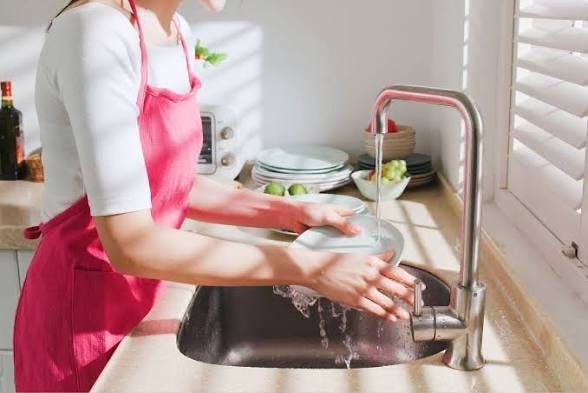
There is something deeply ordinary about planning meals, buying groceries, cutting vegetables, washing dishes, cleaning the refrigerator, and figuring out for the hundredth time what everybody is going to eat tomorrow.
Most of that work will never be memorable, and the people eating the food may have very little idea how much thought goes into keeping meals appearing day after day.
That is all right.
A great deal of homemaking is work that disappears almost as soon as it is finished.
Yet when life is functioning somewhat normally, I like the kitchen to have a rhythm to it.
I like knowing there is food in the house and some idea of what supper will be before five o’clock arrives.
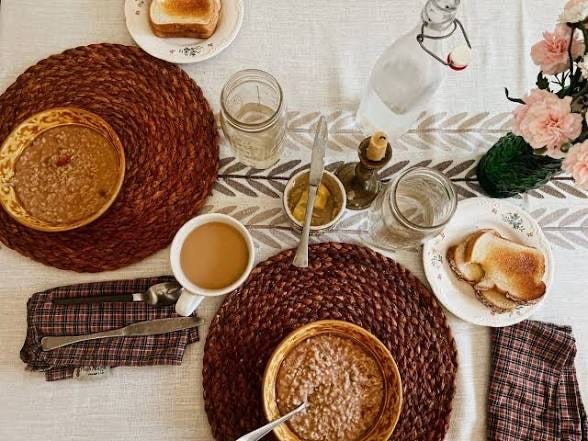
I like hearing people come through asking what smells good, watching somebody lean against the counter to tell me something that happened that day, and eventually seeing everyone gather around the same food.
Because the food is only part of what is being served.
There is something that happens when a family sits down often enough that conversation does not have to be scheduled.
You find out what people are thinking because there is room for the thought to come out naturally.
Somebody mentions something that happened at work, a child tells a story that would never have seemed important enough for a serious conversation, your husband brings up something he has been thinking through, and one subject turns into another while everyone continues eating.
That kind of fellowship cannot be forced very well.
It grows because a family keeps putting themselves in the same place long enough for it to happen.
I think that is one reason the loss of family meals matters more than we sometimes admit.
I am not saying every Christian family needs to sit around the table seven nights a week or that eating pizza in front of a movie once in a while signals the collapse of civilization.
Real families have commitments, church, work schedules, babies, teenagers, illness, and seasons when evenings are simply messy.
But there is a difference between an occasional disruption and a family slowly losing the habit of gathering at all.
If everyone has begun eating alone in whatever corner of the house they prefer, with heated-up takeout in one hand and a device in the other, perhaps it is worth asking what disappeared along with the meal.
Sometimes the answer is conversation.
Sometimes it is simply familiarity with one another.
You can love the people in your house deeply and still become strangely disconnected from their ordinary lives because everybody has become so efficient at living separately.
The kitchen can push back against that.
It gives us a place to say, in the most ordinary way possible, “Come sit down. Tell me about your day. Eat something.”
And then the kitchen has another purpose altogether because Christian fellowship should eventually spill beyond the people whose names are on the mailbox.
Romans 12:13 says we should be “given to hospitality.”
I think Christian women sometimes make hospitality harder than God ever did.
We imagine the house needs to be completely clean, the food needs to be impressive, the children need to cooperate, and the whole evening needs to feel effortless before we are ready to invite anyone inside.
By the time all of those conditions line up, months may have passed.
I know because I’ve been there.
You get busy for a while and tell yourself you will have people over when things settle down.
Then the next thing comes, and the next thing after that, and one day you realize you have been meaning to practice hospitality for half a year.
A Christian kitchen should regularly have other people in it.
Sometimes that means another family crowded around the table.
Sometimes it is one woman sitting with a cup of coffee because life has knocked the wind out of her and she needs somewhere safe to talk.
There are days when the kitchen really does become something of a hospital for the wounded, where the medicine is ordinary food, a chair, enough time to listen, and the feeling that nobody is trying to hurry you out the door.
There may also be a lost person sitting at your table who has never experienced a home where the Lord is genuinely part of the atmosphere.
(I do not mean something staged or performative.)
She may simply notice that there is warmth between husband and wife, that children are treated as people instead of irritations, that gratitude to God is natural, and that the woman serving dinner seems to understand her home as something more than a private retreat from the world.
A young believer may sit there and begin thinking differently about her own home.
Sometimes we teach by letting people see.
That is part of the reason I think we need to keep our kitchens clean in more ways than one.
Yes, I mean the literal dirt.
Counters need wiping, floors need cleaning, dishes need washing, and I have learned that corners left alone long enough will eventually reveal every meal cooked in that room for the last six months.
Caring for the room where food is prepared is simply part of caring for the people eating there.
But I also care about what gets spoken in that kitchen.
I do not want to welcome somebody warmly at the table and then turn her into conversation once the door closes behind her.
I do not want my children learning that hospitality and gossip belong together.
I do not want bitterness toward family members becoming so common in our conversations that the next generation inherits grievances they never personally experienced.
The atmosphere of a kitchen can become dirty long before the floor does.
And mothers have tremendous influence over that atmosphere because so much of family life passes through us.
What are we feeding the people around us besides supper?
Do they leave the table more grateful for their life or more irritated with everybody outside the house?
Are we continually rehearsing what is wrong with people, or is there enough contentment in the room that our children learn how to enjoy what God has actually given them?
I ask myself those questions too.
I am not writing this while standing in an immaculate kitchen with a homemade loaf cooling on the windowsill and three casseroles in the freezer.
Last week my kitchen was barely functioning.
There have been seasons when takeout became far too normal because I had gotten out of the habit of planning ahead.
I have found things in my refrigerator that were old enough to make me question my own housekeeping.
I have gone far too long without inviting people over because life felt busy and I kept assuming hospitality would become easier next month.
That is exactly why I need reminders like this myself.
The point of a Christian home is not perfection.
The point is remembering what these rooms are for before modern life slowly teaches us to use them for something smaller.
When the kitchen gets away from us, we can bring it back.
We can clean the neglected corner, make a grocery list, put something in the oven, call everybody to the table, and begin again without turning the whole thing into a referendum on whether we are good homemakers.
We can look at the calendar and invite someone over before the house feels ready.
We can put the phones somewhere else for one meal and see what happens when everybody has nothing to look at except one another.
We can ask the Lord to help us build something in this room that survives long after the dishes from tonight have been washed and put away.
“Except the LORD build the house, they labour in vain that build it.”
I want Him building mine.
And if the kitchen is the heart of the home, then I want that heart doing what hearts are supposed to do, steadily sending nourishment into everything connected to it.
Some weeks it will hum along beautifully.
Some weeks everyone will be sick and supper will come out of a paper bag.
Then we get well, wash the dishes, gather everybody back around the table, and remember again what we are building.
Biblical Womanhood
If you enjoy this post please ♥️, comment, or share—These simple gestures help share this message with others who may be encouraged and blessed by this ministry.
Pre-order is now open for a week long scriptural study on:
“The Art of Biblical Homemaking”
A home is more than a place to live. It is a place where faith is practiced, relationships are cultivated, character is formed, hospitality is extended, and the goodness of God can be made visible in ordinary life.
This study will help answer three main questions:
What does God say a home is meant to be?
What does Scripture teach about a woman's influence within her home?
How do we translate biblical principles into practical, everyday habits?
Rather than being another homemaking book filled with cleaning schedules and recipes, this is a study of the heart, habits, and spiritual purpose of homemaking, with practical applications that help you live out what you learn.
(This product will be finalized and emailed out by end of day Nov 1. Everyone who pre-orders this study will also receive a surprise free gift when the email goes out!)