Biblical Womanhood
Opening a Time Capsule: Lessons from a 50 Year Old Letter

A dear friend recently shared a unique family letter with me, and I immediately asked if I could share it here with you.
It was written by her husband’s grandmother, Mabel, and his grandfather Henry, in a small farming town in North Dakota on December 29, 1976.
In 1976 their community was participating in a Bicentennial time capsule project, in which letters would be preserved for fifty years and then given to the descendants of those who wrote them.
The following is what Mabel and Henry chose to send forward:
Small farming town, North Dakota
December 29, 1976
Dear Children, Grandchildren, Great-Grandchildren, etc., and Husbands and Wives,
In this Bicentennial year, the community has given us an opportunity to write letters to our descendants, to be preserved for fifty years and then given to our descendants.
We are all busy day by day trying to provide for the necessities of this life. But we know that one day we must die and meet our God. God has given us His word, the Bible, which teaches us about life and death. And it also teaches us that we have a soul that does not die. It will live on forever in either heaven or hell.
We are very thankful to God that we had parents who taught us from the Bible that we were sinners who needed salvation. Also, our parents took us to church where we worshiped God and learned to understand His word. So we have accepted Jesus as our Savior from sin, as we read in I John 1:7, “The blood of Jesus Christ his Son cleanseth us from all sin.”
Jesus, the Son of God, was willing to die on the cross that “Whosoever believeth in Him should not perish but have everlasting life.” John 3:16.
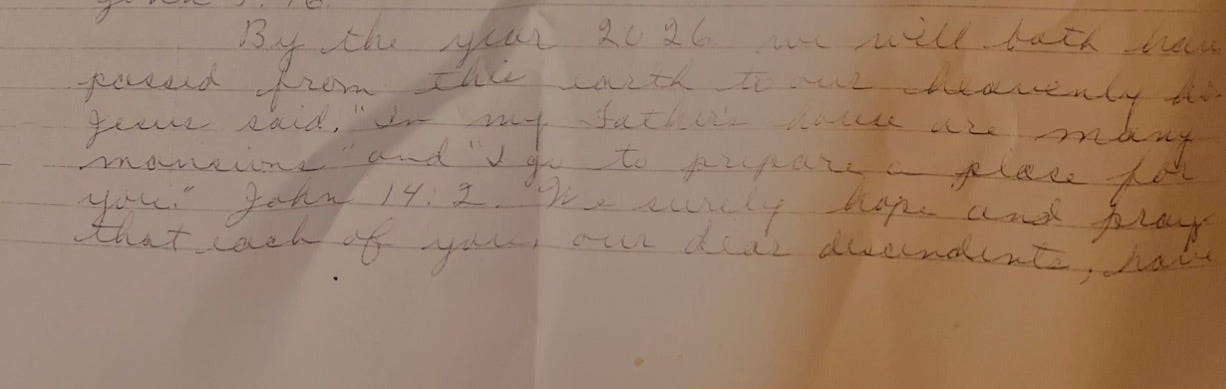
By the year 2026, we will both have passed from this earth to our heavenly home. Jesus said, “In my Father’s house are many mansions” and “I go to prepare a place for you.” John 14:2.
We surely hope and pray that each of you, our dear descendants, have accepted Jesus as your Savior, or that you will do it soon. Do not delay, as there is no chance after death. God says in Hebrews 9:27, “It is appointed unto men once to die, but after this the judgment.”
Some say death is the end, but God says there will be judgment. Believers will be judged for rewards at the judgment seat of Christ. I Cor. 3:13-15 and II Cor. 5:10.
The unsaved will be judged at the Great White Throne judgment, Rev. 20:11-15. “Whosoever was not found written in the book of life was cast into the lake of fire.”
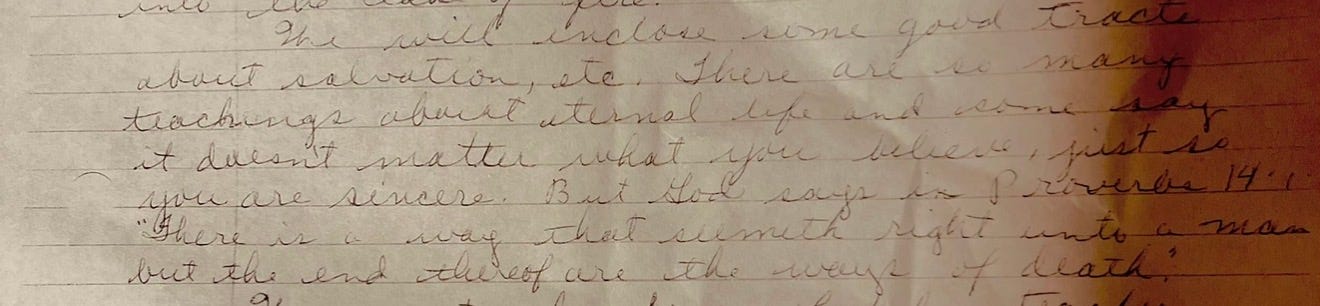
We will enclose some good tracts about salvation, etc. There are so many teachings about eternal life, and some say it doesn’t matter what you believe, just so you are sincere. But God says in Proverbs 14, “There is a way that seemeth right unto a man, but the end thereof are the ways of death.”
We must also beware of false teachers and cults. They will use some scripture and teach things which are not Biblical. II Peter 2:1-
We surely hope that each of you, our dear descendants, will accept Jesus as your Savior and live for Him. Then it will be great joy for us to meet you in heaven.
Lovingly,
Mabel and Henry
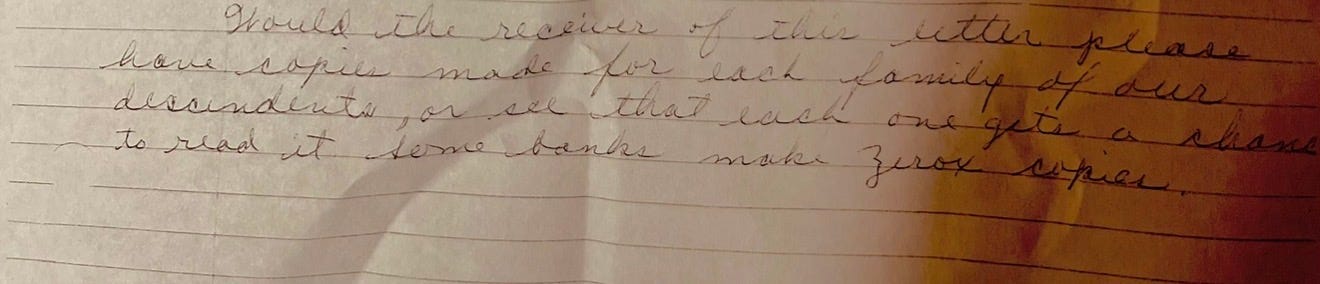
Would the receiver of this letter please have copies made for each family of our descendants, or see that each one gets a chance to read it. Some banks make Xerox copies.
I’ve sat with this letter for a long time this week.
There is so much contained in it, though what struck me most was the complete absence of uncertainty about what mattered.
Mabel knew exactly where she would be in 2026.
Gone.
She simply wrote it.
“By the year 2026, we will both have passed from this earth to our heavenly home.”
The straight forward plainness of that sentence grabbed me.
She did not write as though death were an unlikely interruption somewhere far beyond the edge of life.
She understood that fifty years would pass, another generation would take its place at the table, and that many of the hands holding her letter would likely belong to people she had never met.
She was writing to the future from the full knowledge that she would not be physically present in it.
And when given the opportunity to send one message there, she sent the gospel.
That says something about the way she saw life.
I wonder whether we still possess that kind of eternal eyesight.
We live in a time when death can feel remarkably distant.
Modern medicine has given us blessings Mabel’s generation could scarcely have imagined.
Illnesses that once swept through families can now be treated.
Antibiotics, vaccines, surgeries, emergency medicine, cancer treatments, imaging, and countless other advancements have changed the way many of us experience sickness and mortality.
Thank God for that.
Still, I wonder whether living farther from death has sometimes made us live farther from the awareness of eternity.
Earlier generations knew death differently.
It had a seat at the table.
Mothers buried babies.
Families watched disease move through communities without treatments capable of stopping it.
A minor infection could become a grave concern.
Farming families lived close enough to the land to understand that provision depended upon planting at the proper time, harvesting while there was something to harvest, preserving what could be preserved, and preparing seriously for winters that were coming whether anyone felt ready for them or not.
Life required preparation.
Mabel seems to have carried that same understanding into eternity.
Winter is coming.
Prepare.
Death is coming.
Prepare.
She was not being morbid.
There is nothing gloomy about the letter.
In fact, I find it full of hope.
She believed heaven was real enough to plan for.
She believed hell was real enough to warn about.
She believed salvation through Jesus Christ alone mattered enough to send the message across fifty years.
And she loved people who did not exist yet enough to plead with them.
That moves me the most.
Mabel prayed for descendants whose faces she could not picture.
Some of the people she had in mind had not been born.
Some of their parents may not have even been born.
Yet somewhere in that little North Dakota town, a woman sat down with paper and pen and addressed:
“Children, Grandchildren, Great-Grandchildren, etc.”
I love the “etc.”
It’s as if she were throwing the net as far forward as she knew how.
Whoever you are….
However many generations from me you may be, I have one request….
“Please, come to know Jesus.”
She wrote words that I suspect had already been written deeply into her own heart through years of prayer.
“We surely hope and pray that each of you, our dear descendants, have accepted Jesus as your Savior.”
Then came the urgency.
“Do not delay.”
Mabel understood that eternity does not bend around our schedules.
Hebrews 9:27 says, “And as it is appointed unto men once to die, but after this the judgment.”
There is an appointment on every human calendar that does not appear in our phones.
We do not know its date.
Mabel knew that much, too.
So, she warned her family plainly.
Something else I’ve considered as I’ve read through this letter is that Mabel knew this letter was never a guarantee.
It was a testimony.
A warning.
A prayer placed into the hands of future generations she entrusted to a Holy God, she personally knew.
She recognized that the faithfulness of one generation does not give control over the choices the next generation makes.
Prayer does not turn another human being into a puppet.
Children grow into adults with wills of their own, and some make decisions that break the hearts of the people who prayed most faithfully for them.
Mabel warned those in her immediate and future extended family to beware of false teachers.
She could see the danger of twisting scripture, and wanted those she loved to be forewarned.
She spoke about judgment, the book of life, heaven, hell, false teaching, the blood of Christ, and the absolute necessity of salvation.
I find her willingness to speak so clearly almost refreshing.
We have grown terribly skilled at softening eternal things.
We worry whether words sound too severe.
We hesitate because we do not want anyone uncomfortable.
We speak about faith in vague language that leaves almost enough room for everybody to believe whatever they already believed before we started talking.
But, Mabel was writing to people she already loved.
So she told them the truth.
Somehow we have occasionally convinced ourselves that love avoids uncomfortable truths, while this woman loved future generations enough to tell them that there is a literal judgment and that they needed Jesus before they reached it.
That is love with eternity in view.
I personally feel extremely privileged to experience a portion of Mabel’s answered prayer within my life.
The friend who shared this letter with me is one of those people whose life sharpens mine.
(I’ve written about this friend before:)
I leave time with her encouraged.
Her Christianity has weight to it.
She lives in such a way that deeply convicts me.
There is a steadiness in her testimony, a seriousness about the Lord, and a love for truth that causes me to examine my own walk.
Now I have read the words of her husband’s grandmother from almost fifty years ago, and I cannot help wondering how much of what I see today carries fingerprints from prayers prayed decades before.
We could never measure it.
How many times did Mabel pray for her grandchildren?
How often did she pray for her great-grandchildren she would never meet?
Did she kneel somewhere in that North Dakota home, on that North Dakota prairie, and ask the Lord to keep truth alive in her family long after she was gone?
We cannot know.
Yet we do know that God hears prayer.
And I cannot stop thinking about how far a faithful person’s prayers may travel beyond the reach of their own life.
That thought has convicted me.
What if the spiritual condition of our descendants fifty years from now were somehow connected to the prayers we are praying for them today?
Would there be much to work with?
I pray readily about the things immediately in front of me because immediate things are loud.
There are children and grandchildren I know by name.
There are current needs, decisions, marriages, health concerns, and circumstances that draw prayer almost naturally because I can see them.
Mabel’s letter makes me want to pray farther.
For grandchildren yet to come.
For marriages that have not begun.
For little faces none of us can picture.
For men who will someday lead families connected to ours.
For women who will raise another generation.
For descendants who may live in a world I would no more recognize than Mabel would recognize mine.
Lord, keep them near truth.
Let every future generation come to fiercely love Your Word.
Let Christ be preached in our family long after every person currently sitting around our table is gone.
Preserve them from false doctrine.
Save their souls.
Use them.
That kind of prayer takes the eyes off today.
And perhaps that is one of the things modern life has made difficult for us.
Everything demands immediacy.
Our news is immediate.
Our shopping is immediate.
Our communication is immediate.
Our entertainment is immediate.
Social media asks what we are thinking right now, what we are doing right now, what we are eating, wearing, buying, fearing, celebrating, and arguing about right now.
Mabel wrote for fifty years from now.
That is a vastly different posture.
It makes me wonder what we are leaving behind.
Because in a strange way, we are all building time capsules now.
Our social media accounts alone could probably reconstruct enormous portions of our lives after we are gone.
Imagine your descendants opening yours fifty years from now.
What would they find?
What would they conclude mattered most to you?
Would there be evidence of an earnest Christian trying to live with eternity in view, however imperfectly?
Would they find Scripture?
Would they find the gospel?
Would they see somebody praying over family, loving the brethren, confessing failure, rejoicing in Christ, and trying to leave truth behind?
Or would they mostly discover an enormous record of vanity?
Photographs designed to impress.
Things purchased.
Things complained about.
Arguments that seemed terribly important for forty-eight hours and completely meaningless five decades later.
Ecclesiastes calls it “Vanity of vanities.”
That phrase feels especially sobering when I think about the digital record we are creating.
So much of what occupies us will not matter fifty years from now.
Mabel appears to have understood that before she picked up her pen.
She had one letter.
One chance to speak.
So she spent it on eternity.
And then, at the very end, she wrote one of my favorite lines:
“…Some banks make Xerox copies.”
I smiled when I read it.
Nothing places the letter more firmly in another world than that sentence.
She was concerned that every family member receive her words, and the best practical advice she could give was that perhaps a bank somewhere would make Xerox copies.
Mabel could never have imagined what would happen to those words now.
She could not have conceived of a world where a letter could be photographed instantly and sent across thousands of miles in seconds, where thousands of people could read her testimony without ever touching the original paper, where her words could travel farther in an afternoon than she probably traveled in her entire lifetime.
Yet somehow they did.
She wanted copies made.
She wanted folks in the future to know the truth of the gospel she held dear.
My hope is that this piece, in some small way, helps honor her request.
Fifty years later, Mabel is still telling people about Jesus.
She is still warning people about false teaching.
She is still saying there is a heaven.
There is a hell.
There is judgment.
There is a Savior.
Do not delay.
Her voice outlived her body.
Psalm 90:12 says, “So teach us to number our days, that we may apply our hearts unto wisdom.”
Mabel numbered hers.
She knew she would not see 2026.
And because she knew that, she used 1976 to speak into it.
Here’s what I hope we can all learn from Mabel’s letter—
That we ought to think farther ahead than next week.
That we ought to pray beyond the people whose faces we know.
That Biblical TRUTH from 50 years ago, is still Biblical TRUTH today—and each day forward.
And that we ought to do our part to ensure that same TRUTH survives us.
That we need to leave behind something more durable than possessions and photographs.
We need to write things worth finding.
We need to share with our children what we believe, and why.
We need to speak boldly and plainly about Biblical salvation.
We need to teach Scripture deeply enough that another generation can carry it after our voice has disappeared from the room.
And lastly, we need to live with enough eternity in our eyesight that the present world never becomes large enough to convince us it is all there is.
Modern medicine may allow us to postpone thinking about death.
Modern culture may distract us from it.
Neither have ever changed the appointment.
One day somebody else will possess the things we worked so hard to obtain.
Our names will slowly move from present conversation into family history.
But the truth we planted may still be growing.
The prayers may still be receiving answers.
The gospel may still be moving through another generation.
That is the sort of legacy I want.
And perhaps fifty years from now, if the Lord tarries, somebody connected to our families will look backward upon our lives with the same gratitude I felt reading Mabel’s letter and realize that long before anyone knew their name, someone was already asking God for their soul.
What power there is in that thought.
Mabel wrote to 2026 because she knew she would be gone when it arrived.
She wanted one thing understood when her descendants finally opened her letter.
Know Christ.
Live for Him.
Love His Word.
Stick with the truth.
And someday, by the grace of God, may we meet in heaven.
Almost fifty years later, I cannot think of anything more important she could have said.
Truly Inspired,
Biblical Womanhood
If the ministry at Biblical Womanhood has been a blessing to you, would you consider becoming a paid subscriber? Every subscription helps get content like this out for others.
If you’re not really able to do a subscription, you can also donate as a one time gift here:
Private reading measurement
We count reading sessions after 30 seconds on a visible page and two interactions. A random browser ID lasts up to 30 days. Reports use approximate countries and hide groups smaller than 10 browser IDs. Your notes, verses, article text and email are not included.
Measurement is off. Browser privacy signals also take precedence.
Your reading place and bookmarks are saved on this browser.