The flood killed everything that breathed. Giants are walking around on the far side of it.
Both are scripture. Both are plain. I said the Book tells you what crossed.
Here is the answer. It is not the one you have been sold.
First, kill the easy way out
Ask the internet how giants survived the flood and you get one answer, dressed up four different ways.
The bloodline came aboard. One of the wives carried it. Ham’s wife, usually, because Ham is convenient. The corruption walked onto the ark inside somebody’s DNA and walked back off eight months later.
It is a tidy answer. It is also not in the text.
Read what Genesis actually says about who was on that boat.
“All in whose nostrils was the breath of life, of all that was in the dry land, died.” (Genesis 7:22)
And read what it says about the eight.
Noah was perfect in his generations. The text is careful about that word. Nothing on the ark is described as compromised. Nothing. The whole point of the account is a clean remnant carried through a total judgment, and the moment you smuggle a giant bloodline onto the ark you have not solved the problem. You have gutted the flood.
If corruption survived, the water failed.
Genesis does not say the water failed.
So look at what happens next
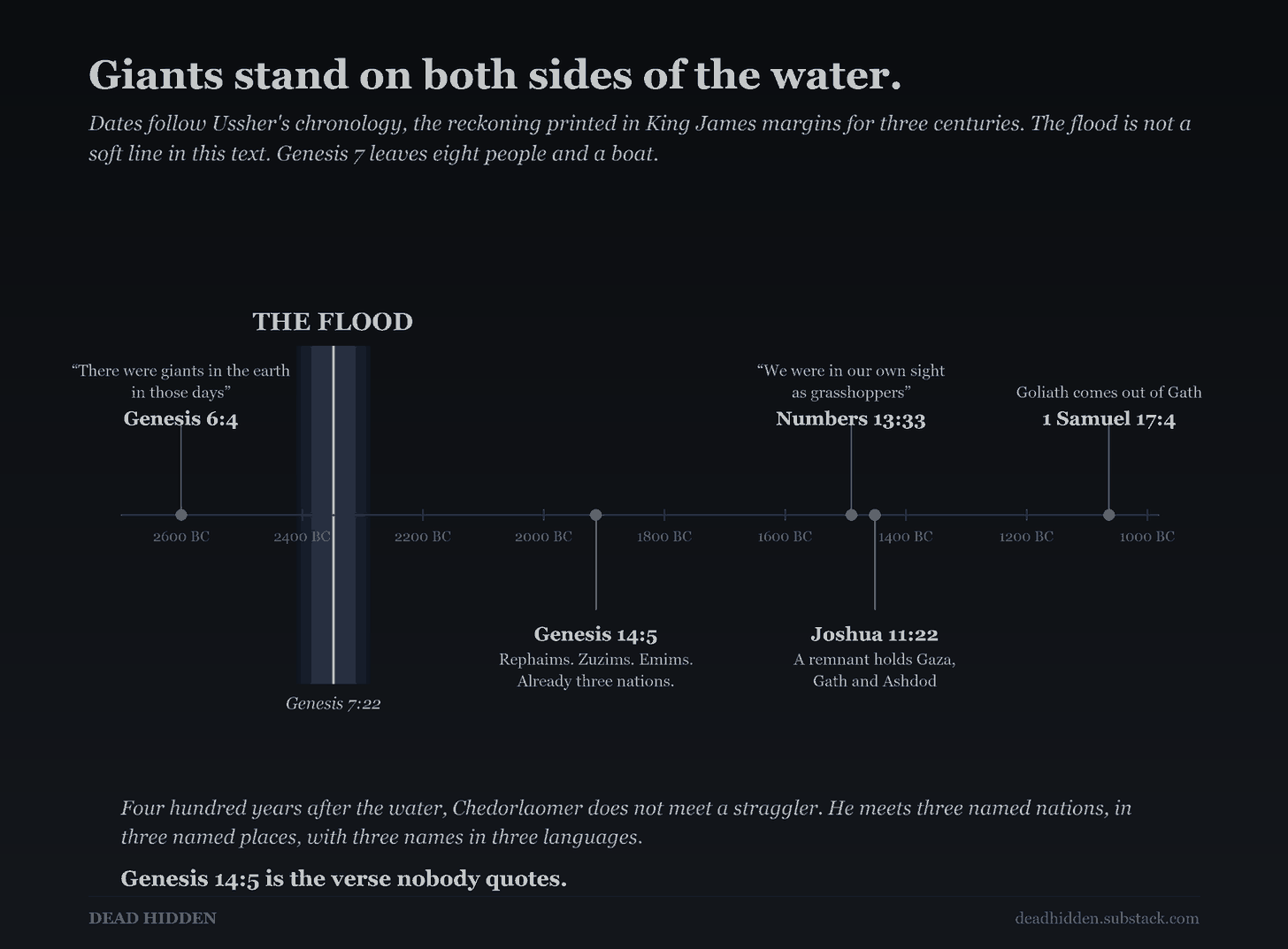
Four hundred years pass. Abram is alive. Four kings come up out of the east on a raid, and Moses records who they hit on the way.
“And in the fourteenth year came Chedorlaomer, and the kings that were with him, and smote the Rephaims in Ashteroth Karnaim, and the Zuzims in Ham, and the Emims in Shaveh Kiriathaim,” (Genesis 14:5)
Read that again slowly.
Not a survivor. Not a rumor. Three peoples. Three names. Three cities with addresses.
Chedorlaomer is not hunting a legend. He is running a military campaign against established nations, and the giants are on his route like any other kingdom he has to go through.
Four centuries after a flood that killed everything with lungs, they are not hiding in a cave. They have infrastructure.
Genesis 14:5 is the verse nobody quotes. I do not know why. It does more damage to the tidy answer than anything in Deuteronomy.
The neighbours had their own words for them
Here is the part that stopped me.
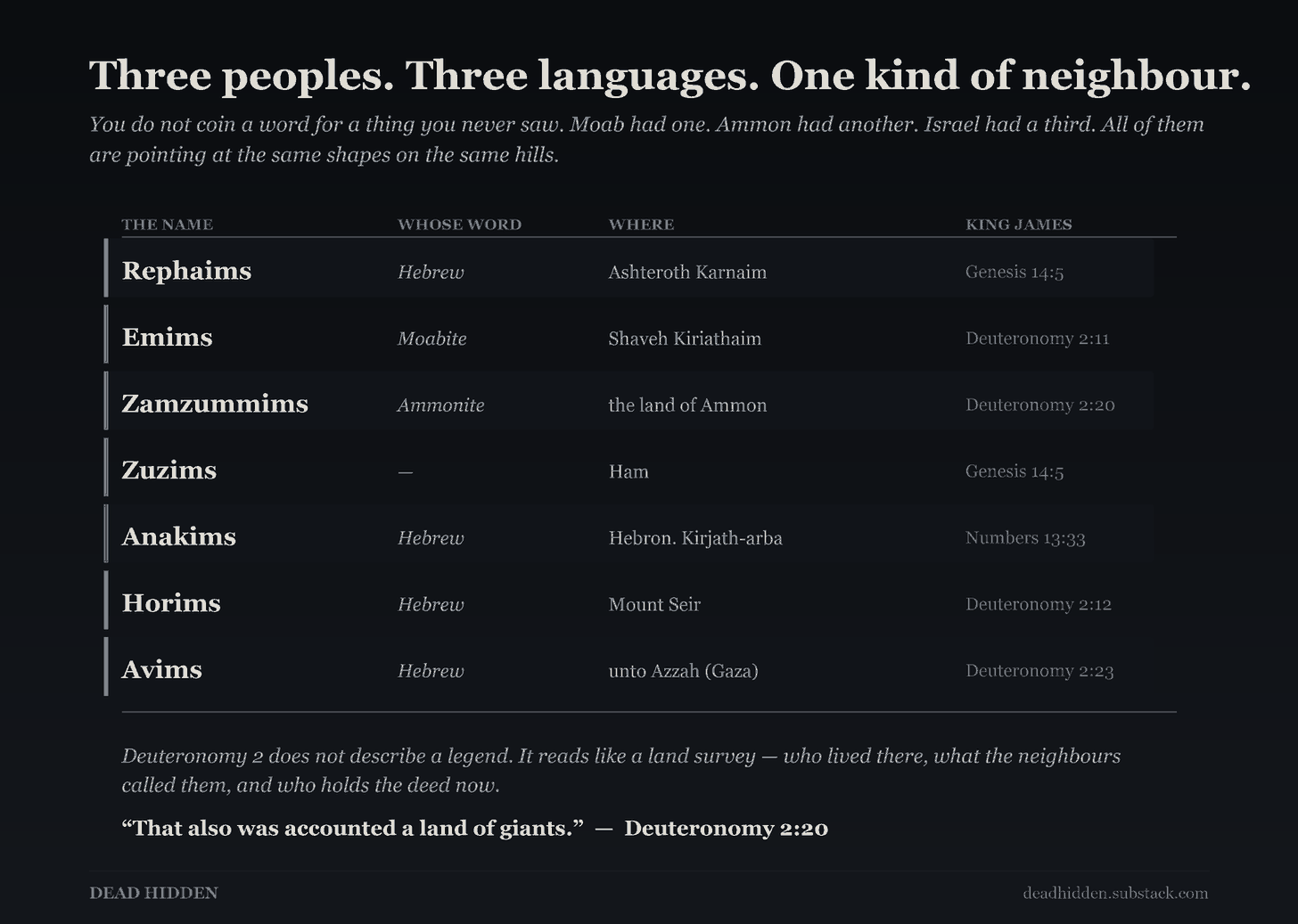
By the time Israel comes up out of Egypt, Moses is not introducing a new idea. He is doing paperwork. Deuteronomy 2 reads like a land survey. Who lived here. What the neighbours called them. Who holds the deed now.
“The Emims dwelt therein in times past, a people great, and many, and tall, as the Anakims; Which also were accounted giants, as the Anakims; but the Moabites call them Emims.” (Deuteronomy 2:10-11)
“That also was accounted a land of giants: giants dwelt therein in old time; and the Ammonites call them Zamzummims;” (Deuteronomy 2:20)
Moab had a word. Ammon had a different word. Israel had a third.
You do not coin a word in your own language for something you never saw. You do not need a name for a thing that is not on your border.
Three separate peoples, speaking three separate tongues, all built vocabulary around the same shapes on the same hills.
Then what crossed?
Nothing crossed.
That is the answer, and it is sitting in the verse everybody has already memorized without hearing it.
“There were giants in the earth in those days; and also after that, when the sons of God came in unto the daughters of men, and they bare children to them, the same became mighty men which were of old, men of renown.” (Genesis 6:4)
Four words in the middle of that verse. And also after that.
Moses is writing centuries downstream of the flood. He knows what happened in his own century. He is not being mysterious. He is telling you the arrangement in verse 4 was not a one-time event, and he says so in the same breath he uses to describe the first one.
The giants after the flood are not survivors.
It happened again.
That is not a loophole in the judgment. That is a second offense.
Who drowned, and what could not
Psalm 82 opens somewhere most men have never pictured.
“God standeth in the congregation of the mighty; he judgeth among the gods.” (Psalm 82:1)
A courtroom. God is presiding. He is judging beings the King James is comfortable calling gods, and He hands down the sentence Himself.
“I have said, Ye are gods; and all of you are children of the most High. But ye shall die like men, and fall like one of the princes.” (Psalm 82:6-7)
Ye shall die like men. That is the sentence for the ones who could die.
Now hold that next to Jude, who is describing a different group entirely.
“And the angels which kept not their first estate, but left their own habitation, he hath reserved in everlasting chains under darkness unto the judgment of the great day.” (Jude 6)
Kept not their first estate. Left their own habitation. Both phrases describe leaving an assigned place, and Jude puts that sin two verses away from Sodom and strange flesh. He does not say they died.
He says they are held.
Peter says the same thing with harder edges.
“For if God spared not the angels that sinned, but cast them down to hell, and delivered them into chains of darkness, to be reserved unto judgment;” (2 Peter 2:4)
The offspring drowned. The fathers went into chains.
Which means the flood ended a generation. It did not end the possibility.
Now let me take something away from you
I have to, or the rest of this is worthless.
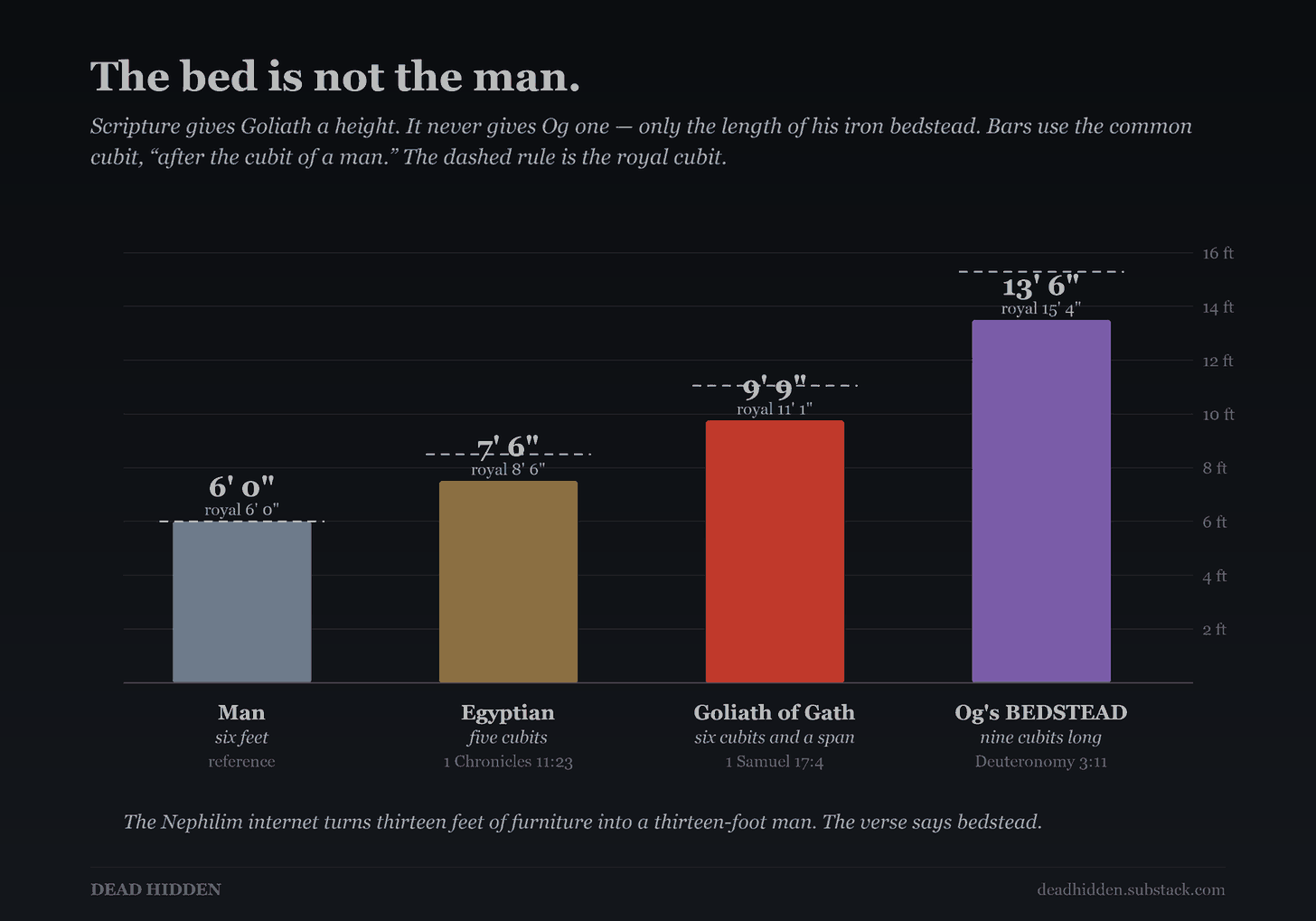
You have seen the picture. The thirteen-foot skeleton. The iron bed of Og held up as proof of a thirteen-foot man.
Read the verse.
“For only Og king of Bashan remained of the remnant of giants; behold, his bedstead was a bedstead of iron; is it not in Rabbath of the children of Ammon? nine cubits was the length thereof, and four cubits the breadth of it, after the cubit of a man.” (Deuteronomy 3:11)
Nine cubits was the length of the bedstead. Not the man.
Scripture gives Goliath a height and never gives Og one. Six cubits and a span, 1 Samuel 17:4. Around nine feet nine. That is enough. That is a man no one in that valley would face, and the text did not need to round him up.
I am not going to inflate a giant to win an argument. The King James is not short on material here and it has never once needed my help.
The men selling you the tall skeletons are not being careful with you. Watch how fast they reach for a photograph and how slow they are to read you the verse.
One more thing, and this one matters
There is an argument going around that Deuteronomy 32:8 proves a divine council, that the nations were divided according to the number of the sons of God.
Open your King James.
“When the most High divided to the nations their inheritance, when he separated the sons of Adam, he set the bounds of the people according to the number of the children of Israel.” (Deuteronomy 32:8)
Children of Israel. That is what your Bible says.
The other reading comes out of the Dead Sea Scrolls and the Greek. It may well be a real textual question, and I am not here to tell scholars their business. But I am not going to hand you an argument that requires a manuscript you do not own and cannot check.
You do not need it.
Psalm 82 already put God in a courtroom full of gods, in the King James, on the page in your lap. Jude already put the angels in chains. Genesis already said and also after that.
Every load-bearing beam in this study is in the Book you already have.
That is the whole reason Dead Hidden exists.
Where this leaves you
The flood was total. The giants came back. The text says how, in four words, in a verse you have read a hundred times.
And the last giant in this account does not die in Deuteronomy. He walks out of Gath, five hundred years later, and stands in a valley shouting at an army until a boy with a sling ends the bloodline in one afternoon.
Joshua left three cities standing. Gaza. Ashdod. Gath.
Somebody always leaves a door open.
Read it for yourself.
Everything above came out of the King James and nowhere else. No Enoch. No Jasher. No Dead Sea Scrolls. Seven passages most men have never had read to them in a church service.
That is not an accident, and it is not a conspiracy. It is just what happens when a book gets taught in highlights.
I put the whole method into the guides. How to read a passage until it stops being a slogan and starts being a document. What to do when two verses will not sit down together. Where the seams are.
Start free. THE FALSE LIGHT is the Dead Hidden companion to this study, and it costs nothing: https://biblicalman.gumroad.com/l/false-light
Or take the whole shelf. The Essential Arsenal is ten guides, the complete set: https://biblicalman.gumroad.com/l/uvknc
Read it slow. Read it out loud. And when the text will not sit down, do not make it.
Ask it what it is trying to tell you.