There are stories in the Bible that we become so familiar with that we stop noticing the small things, though sometimes it is the smallest detail that opens the whole passage in a new way.
I have read the account of the rich man and Lazarus many times.
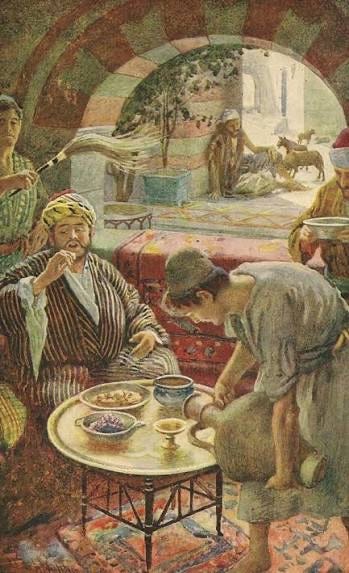
I have pictured the rich man clothed in purple and fine linen, moving through his days beneath the admiration of people who knew exactly who he was.
I have pictured the feasts, the polished vessels, the servants passing through crowded rooms, and the sound of laughter spilling beyond the walls of a house where nothing seemed scarce.
His table was full, his clothing was costly, and his life carried all the visible marks by which men usually measure importance.
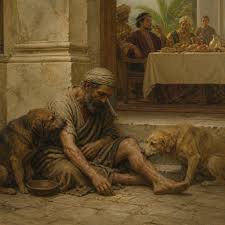
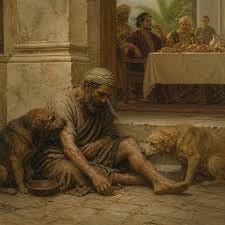
Outside his gate lay a beggar.
His body was covered with sores.
Hunger had reduced his hopes to crumbs.
He no longer dreamed of sitting at the rich man’s table or being welcomed into the warmth of the house.
He desired only what fell from it, those forgotten pieces swept aside after abundance had eaten its fill.
Even the dogs came and licked his sores, and there is something almost unbearable in that picture, because it tells us how low a man may be brought while the world continues eating supper only a few steps away.
Then one detail caught hold of me.
We know the beggar’s name.
“ And there was a certain beggar named Lazarus, which was laid at his gate, full of sores.” Luke 16:20.
Lazarus had no station among men.
He possessed no title, no estate, no influence, and apparently no strength left to improve his circumstances.
People may have stepped around him on their way through the gate, drawing their robes aside to avoid touching him, while barely allowing themselves to look into his face.
Yet his name was known in heaven.
The rich man, who was likely known throughout his city, is never named in the passage.
Men may have spoken his name with respect while he lived.
Merchants may have competed for his business.
Guests may have regarded an invitation to his table as a mark of favor.
Perhaps his name appeared on property, accounts, agreements, and announcements, attached to everything he owned and everything he had accomplished.
Scripture simply calls him “a certain rich man.”
All the names by which the world had known him disappeared when eternity began.
Lazarus, whose name may have meant almost nothing to the people who passed his broken body each day, has been remembered for centuries.
The beggar entered eternity with little that earth considered worth recording, yet the Lord recorded the one thing that finally mattered.
His name.
“And it came to pass, that the beggar died, and was carried by the angels into Abraham’s bosom.” Luke 16:22.
I love that Luke tells us he was carried.
Perhaps no gentle hands had lifted him for a very long time.
He had been laid at the gate, which suggests that he could not place himself there, and once abandoned upon the ground he remained beneath the notice of those who had somewhere more important to be.
When death finally released him from that diseased body, heaven sent angels to carry the man earth had left lying in the dust.
The rich man died also, and he was buried.
I imagine his burial was impressive.
A man who had lived richly would likely have been mourned publicly, wrapped carefully, carried with ceremony, and placed in a tomb suited to his station.
People may have spoken warmly of his success, his influence, and the life he had built.
Then his eyes opened in hell, a literal, physical place.
“And in hell he lift up his eyes, being in torments, and seeth Abraham afar off, and Lazarus in his bosom. And he cried and said, Father Abraham, have mercy on me, and send Lazarus, that he may dip the tip of his finger in water, and cool my tongue; for I am tormented in this flame.” Luke 16:23.
Death stripped both men of every earthly appearance.
Purple linen could not follow the rich man into eternity, and the sores of Lazarus could not follow him into comfort.
The gate was gone.
The table was gone.
The crowd was gone.
What remained was the condition of each soul before God.
The rich man did not go to hell because he had money, just as Lazarus did not enter comfort because he lacked it.
Abraham himself had possessed great wealth.
The difference reached far deeper than what either man held in his hands.
One man died in faith.
The other died in his sins.
The rich man had enjoyed good things without ever preparing to meet the God who gave them.
He had lived as though comfort were enough, as though abundance could silence eternity, and as though the beggar outside his gate were someone else’s concern.
Once death came, he discovered that wealth could purchase many things during life while remaining powerless to ransom a soul.
“What shall it profit a man, if he shall gain the whole world, and lose his own soul?” Mark 8:36.
That question follows me through the story.
What would it matter if every person in town knew my name while the Lord did not claim me as His own?
What would it matter if my life looked full, successful, respectable, and secure, while my name remained absent from the book of life?
What comfort could reputation offer when the last breath had been drawn and the soul stood uncovered before God?
I would rather be Lazarus.
I would rather be the beggar with a name than the rich man whose identity was swallowed by his unbelief.
I would rather enter heaven unknown by the world than enter hell remembered by everybody I left behind.
There is a book in heaven that no human hand keeps, containing names that may never have appeared in history books, on buildings, beneath portraits, or before crowds.
The Lord Jesus told His disciples, “Rejoice, because your names are written in heaven.” Luke 10:20.
That is the honor every soul should desire.
To have a name written in heaven, however, requires more than being poor, humble, religious, sincere, or sympathetic.
Lazarus was not saved by suffering.
Pain does not cleanse sin, and poverty cannot reconcile a man to God.
Every person, whether lying at a gate or sitting behind one, has sinned against a holy God.
“For all have sinned, and come short of the glory of God.” Romans 3:23.
That little word “all” gathers the rich and poor into the same need.
It gathers the respectable woman whose life appears orderly, the man whose sins are known throughout town, the church member, the skeptic, the generous, the selfish, the educated, the forgotten, and the admired.
We have all come short, and no amount of earthly goodness can carry us across the distance our sin has created.
“The wages of sin is death.” Romans 6:23.
Sin earns a wage, and every one of us has to pay for our sins one day.
The second death, eternal separation from God, waits beyond the grave for every soul that remains unforgiven.
The rich man discovered this when discovery could no longer lead to repentance, because the grave had fixed his eternal condition.
Yet the same verse that tells us what sin earns also tells us what God gives.
“But the gift of God is eternal life through Jesus Christ our Lord.” Romans 6:23.
A gift cannot be earned through righteous behavior, religious devotion, sacrifice, baptism, church membership, or a sincere attempt to become a better person.
Eternal life comes through Jesus Christ because He did what none of us could do.
He lived without sin, went willingly to Calvary, and bore in His own body the judgment our sins deserved.
“But God commendeth his love toward us, in that, while we were yet sinners, Christ died for us.” Romans 5:8.
He died for us while we were sinners.
He did not wait for us to clean ourselves, repair our past, master every temptation, or prove ourselves worthy of mercy.
He knew every ugly thing, every secret thought, every failure, and every sin we would rather keep hidden, and still He went to the cross.
His blood was shed because “without shedding of blood is no remission.” Hebrews 9:22.
He was buried, and on the third day He rose again, conquering the death that had held every other man.
The gospel rests upon that finished work:
“that Christ died for our sins according to the scriptures; And that he was buried, and that he rose again the third day.” 1 Corinthians 15:3–4.
Salvation comes when a sinner turns from every hope in self and believes on the Lord Jesus Christ.
When the Philippian jailer asked, “What must I do to be saved?” the answer was wonderfully plain.
“Believe on the Lord Jesus Christ, and thou shalt be saved.” Acts 16:31.
To believe upon Him means more than agreeing that Jesus once lived, because even the devils believe and tremble.
It means resting the whole weight of your soul upon who He is and what He accomplished, receiving Him as the only Savior able to forgive your sin and give you everlasting life.
“For whosoever shall call upon the name of the Lord shall be saved.” Romans 10:13.
Whosoever.
The rich man could have come.
Lazarus could come.
You can come.
No one is too poor to receive Him, too stained to be washed, too forgotten to be known, or too far gone to be saved while breath remains. Christ said, “Him that cometh to me I will in no wise cast out.” John 6:37.
Perhaps your name is known in many places.
Perhaps it is known in very few.
There may be people who speak it with affection, others who speak it carelessly, and some who have forgotten it altogether.
One day every earthly voice that ever said our names will grow silent, and the records men kept will fade with the world that made them.
What matters is whether Jesus knows your name.
The thought humbles me, because I know His name.
I know the name that is above every name.
I know the name spoken by the angel before His birth, preached by apostles, hated by devils, whispered by martyrs, and called upon by sinners who had nowhere else to turn.
Jesus.
I know my Savior’s name.
The sweetest name I know.
Yet the sweeter wonder is that He knows mine.
He knew it before anyone else ever spoke it.
He knew it when I wandered, when I sinned, when I tried to hide from His voice, and when I finally came with nothing in my hands that could purchase mercy.
By grace, through faith in His shed blood and resurrection, my name has been written in heaven, secure in the promise of the One who said of His sheep, “I give unto them eternal life; and they shall never perish, neither shall any man pluck them out of my hand.” John 10:28.
My salvation is held by hands stronger than mine.
My name rests in a record I did not write and cannot maintain through my own goodness.
It is there because the Lamb was slain.
Revelation speaks of “the Lamb’s book of life,” and I cannot think of those words without remembering the blood by which I was redeemed.
My name is there through the merit of Christ, written, as it were, in the testimony of wounds that will forever declare my debt was paid.
I would rather have that name than every title earth could give me.
I would rather be carried by angels from a beggar’s gate than carried by mourners from a palace into a Christless eternity.
I would rather have crumbs with Jesus than a feast without Him.
When the rich man’s table had vanished and Lazarus’s hunger had ended, only eternity remained, and eternity revealed whose name had truly mattered all along.
I know my Savior’s name.
More precious still, He knows mine.
And when the records of this world have crumbled into dust, my name will remain where grace placed it, in the Lamb’s book of life, because Jesus saved me and keeps me for His own.
Does He know your name?
Biblical Womanhood
If this ministry has blessed you, would you ♥️, comment, or share? Paid subscribers and founding members help keep Biblical Womanhood alive; founding members receive my 2026 digital products free.
*The AI detector is turned off on my posts. If you have questions about how I use AI to edit my posts please ask me, I’m a real person who values honesty and transparency person to person.