Hit the heart. ❤️ Restack it.
It was Monday morning, and Jesus was hungry.
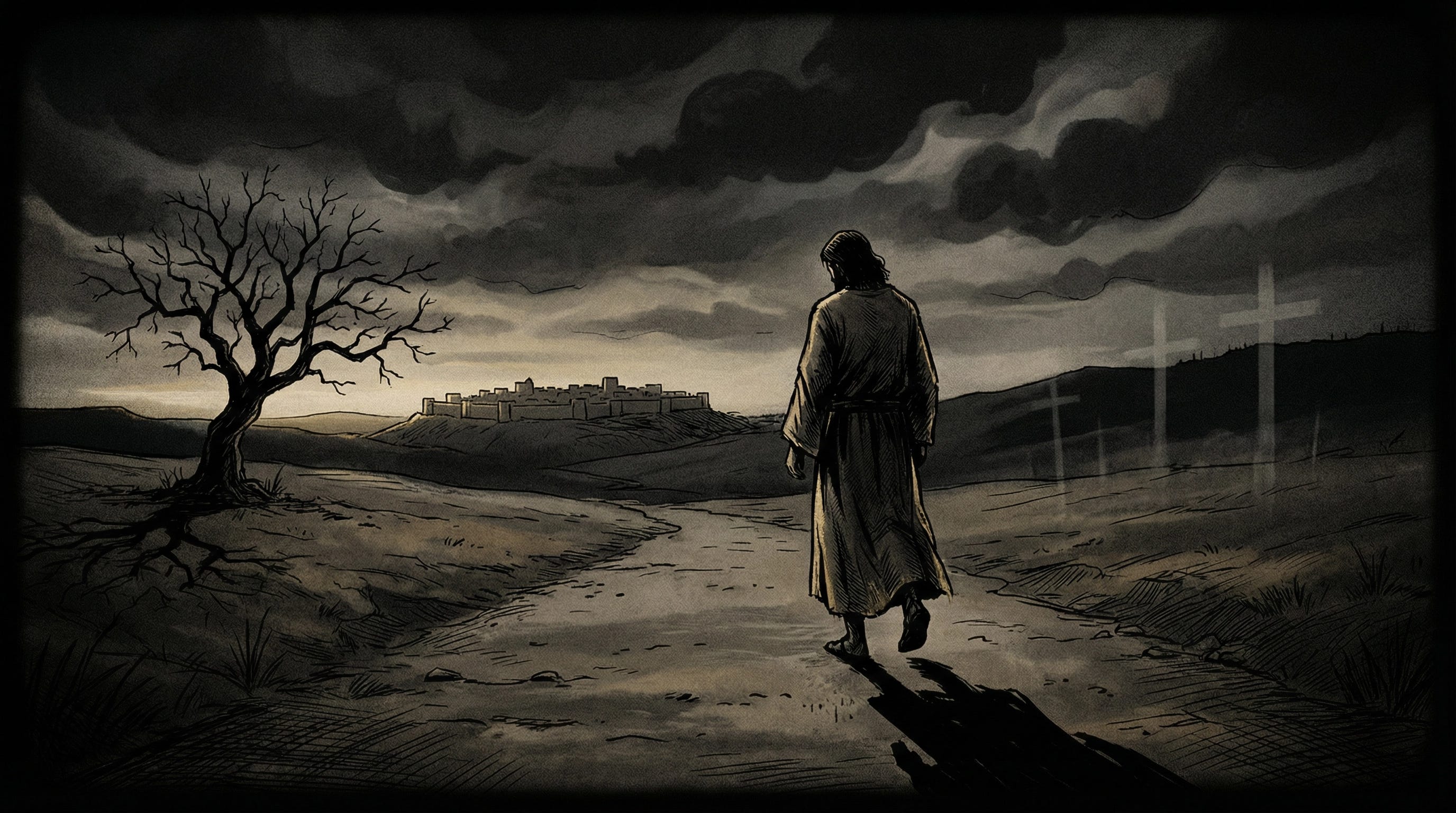
That’s the detail that gets me. The Son of God, the one who spoke the oceans into existence and hung every star by name, walking down a dirt road outside Jerusalem with His stomach growling like a stray dog.
He’d slept outside the night before. Probably on the Mount of Olives. No pillow. No roof. The God who made the cedars of Lebanon didn’t have a bed. He’d been walking for days. Jericho to Bethany to Jerusalem and back again, thirteen miles one way, two miles the next, dust on His feet, prophecy in His skull like a loaded gun He couldn’t put down.
He saw a fig tree. Full of leaves. Looked alive from a distance. The kind of tree that should have had something on it.
He walked up to it.
Nothing. Not a single fig. All leaf, no fruit. Beautiful from the road. Barren up close.
He cursed it. Spoke it dead where it stood.
The disciples heard it. You can almost see them glancing at each other. What just happened?
Israel. That’s what happened. A nation that looked alive from a distance — the temple, the priests, the robes, the phylacteries, the long prayers on the street corner. Gorgeous from the road. Get close, and there’s nothing there. All performance. No fruit. And the Owner of the vineyard just pronounced the sentence.
The kingdom of God shall be taken from you, and given to a nation bringing forth the fruits thereof. — Matthew 21:43
That tree never grew another leaf. And within forty years, Jerusalem burned.
He kept walking. Stomach still empty. Fig tree dead behind Him. Cross two days ahead.
He went into the temple. His Father’s house.
He’d been there the night before. Sunday evening. Walked in, looked around, said nothing. Just observed. Took it all in. The money changers with their rigged scales. The dove sellers gouging poor women who couldn’t afford a lamb. The whole filthy economy built inside the house of God like a parasite living in the walls of a church.
He saw it all. And He left.
Went back to Bethany. Slept on it.
That’s the detail that should terrify every man who thinks God doesn’t notice. He noticed on Sunday. He acted on Monday. The gap between observation and judgment was exactly one night.
He walked in Monday morning and started flipping tables.
Not a tantrum. Not an outburst. Cold, calculated, righteous violence. He overturned the money changers’ tables. Coins scattering across stone like teeth knocked out of a mouth. Kicked over the seats of the dove sellers. Drove them out. Wouldn’t even let anyone carry merchandise through the temple.
The whole corrupt system — scattered on the floor.
My house shall be called of all nations the house of prayer; but ye have made it a den of thieves. — Mark 11:17
Den of thieves. Not “a place that could use some improvement.” Not “a space that needs reimagining.” A den of thieves. The kind of place where criminals hide between jobs. And He cleaned it out with His hands.
Now back up.
You need to understand what happened the day before to understand why Monday morning hit the way it did.
Sunday. Palm Sunday. He rides into Jerusalem on a donkey. Not a war horse. Not a stallion. A young donkey — the least respected animal in the Middle East. Considered the stupidest creature alive. So derogatory that even today, Arab militias use words that rhyme with it as the worst insult they’ve got.
He picked it on purpose. Because He’s meek. And so is the donkey. And because Zechariah 9:9 said it would happen that way five hundred years before it did.
Behold, thy King cometh unto thee: he is just, and having salvation; lowly, and riding upon an ass, and upon a colt the foal of an ass. — Zechariah 9:9
The crowd went insane. Hosanna. Blessed is He that cometh in the name of the Lord. Palm branches on the ground. Coats in the road. A king’s welcome for a man on a donkey.
Within forty-eight hours, the same mouths would be screaming Crucify Him.
Same crowd. Same voices. Sunday worship to Wednesday murder in the span of a few meals.
That’s the fickleness of man. The crowd is never yours. It was never His either.
He stopped just outside the city walls. Looked at Jerusalem spread out below Him.
And He wept.
And when he was come near, he beheld the city, and wept over it. — Luke 19:41
Not for Himself. For them. For a city that could have had peace and chose war instead. For people who would wave palms on Sunday and swing hammers on Friday.
Back up further. Before the donkey. Before the crowd.
He’s on His way to Jerusalem. Walking south from Jericho. He knows — knows with the specificity of a man reading his own autopsy report — exactly what’s waiting.
For he shall be delivered unto the Gentiles, and shall be mocked, and spitefully entreated, and spitted on: And they shall scourge him, and put him to death. — Luke 18:32-33
He told the twelve to their faces. Delivered. Mocked. Spit on. Scourged. Killed.
He knew Psalm 22 — the prophetic script of His own crucifixion, written a thousand years before crucifixion was invented. He knew Isaiah 50 — His back given to the smiters, His beard ripped from His face. He knew Isaiah 53 — wounded for our transgressions, bruised for our iniquities. He knew they’d strip Him naked and gamble for His clothes at the foot of the cross like drunks dividing a dead man’s belongings.
Every detail. Loaded in His mind like rounds in a magazine.
He steadfastly set his face to go to Jerusalem. — Luke 9:51
And He walked toward it.
But here’s the thing that wrecks me.
With all of that in His skull — every prophecy, every spit, every nail — He stopped on the road to Jericho for a blind beggar.
Luke 18:35. A man nobody wanted to look at sitting in the dirt by the road. Crying out. People telling him to shut his mouth. And Jesus — days from the cross, hours from a dead fig tree and a flipped table and a corrupt religious machine trying to kill Him — stops.
Heals him. Tells him his faith made him whole.
Then He walks into Jericho and finds a crooked little tax collector named Zacchaeus hiding in a tree. Everybody in town hates this man. He’s a thief and they all know it. And Jesus looks up through the branches and says, Come down. I’m eating at your house today.
The crowd murmured. Gone to be guest with a man that is a sinner.
Yeah. That’s the whole point.
For the Son of man is come to seek and to save that which was lost. — Luke 19:10
With the cross in His sightline He stopped for a blind man and a crook. Didn’t rush past them. Didn’t say I’m busy, I’ve got an execution to prepare for. He stopped. Because mercy was the mission even on the way to the slaughter.
Let me tell you something. If the Son of God can stop to show mercy to sinners on His way to die, you can stop complaining about your week long enough to look your wife in the eye and ask how she’s doing.
Saturday night before all of this. He’s in Bethany. At supper. Simon’s house. His friends are there — Lazarus, Martha, Mary. The siblings. His people.
Mary does something nobody expects.
She takes a pound of spikenard. Pure. Worth three hundred pence — a full year’s wages for a working man. She breaks it open. Doesn’t pour a little. Breaks the whole thing. Gets on her knees and anoints His feet with it. Wipes them with her hair. The fragrance fills the entire house like smoke from an altar.
Judas can’t stand it.
Why was not this ointment sold for three hundred pence, and given to the poor? — John 12:5
Sounds noble. Sounds generous. Sounds like the kind of thing that gets likes.
The Bible guts him:
This he said, not that he cared for the poor; but because he was a thief, and had the bag, and bare what was put therein. — John 12:6
He was the treasurer. He had the money bag. He was skimming off the top. Three hundred pence in that bag meant thirty or sixty in his pocket. He wasn’t angry about waste. He was angry about lost revenue.
That’s religious outrage for you. Sounds holy on the surface. Peel it back and there’s a thief underneath counting coins.
Jesus shut him down with three words:
Let her alone. — John 12:7
Leave her alone. She’s done a good work. She’s done what she could. And this is going to be remembered wherever the Gospel is preached in the whole world.
Two thousand years. You’re reading about her right now. Judas is remembered as a traitor. Mary is remembered as the woman who poured everything out.
You won’t regret giving your best. Not your money. Not your time. Not your reputation. Pour it out. He remembers.
Monday afternoon. After the tables, the coins, and the dove sellers running.
The Pharisees huddle up.
The scribes and chief priests heard it, and sought how they might destroy him: for they feared him, because all the people was astonished at his doctrine. — Mark 11:18
They feared Him. Not because He had an army. Because He had the truth. And the truth was emptying their temple and threatening their income and their power and their long robes and their chief seats and their whole disgusting religious economy.
They start looking for a weapon. They’ll find one. His name is Judas and he’s already angry about the perfume.
Tuesday He comes back. The fig tree is dead. Withered from the roots. The disciples are stunned.
He walks back into the temple and starts teaching in parables. The vineyard. A man plants it, rents it out, sends servants to check on it. The tenants beat the servants and send them back. He sends more. They beat those too. Finally he sends his son — his only son, his beloved son.
They kill him.
The Pharisees’ faces go white. They know He’s talking about them. They’re the wicked tenants. The prophets were the servants. And the Son standing in front of them is the one they’re about to murder.
And when the chief priests and Pharisees had heard his parables, they perceived that he spake of them. — Matthew 21:45
Then they try to trap Him with words. Is it lawful to give tribute to Caesar? What’s the greatest commandment? Whose wife is she in the resurrection? Theological landmines. Every question designed to blow up in His face.
He answers every single one. Not one trap springs.
And then — two days from the nails — He unloads both barrels.
Matthew 23. Seven woes. The last public sermon He’ll ever preach.
Woe unto you, scribes and Pharisees, hypocrites. You shut up the kingdom of heaven against men. You devour widows’ houses and for a pretense make long prayer. You compass sea and land to make one convert and make him twofold more the child of hell than yourselves. You blind guides. You strain at a gnat and swallow a camel. You clean the outside of the cup and inside it’s full of extortion and excess. You whited sepulchres — beautiful on the outside, full of dead men’s bones.
Seven times. Woe. Woe. Woe. Woe. Woe. Woe. Woe.
With two days to live He spent His last public breath telling the truth about the religious establishment. Not softening it. Not qualifying it. Not adding a “but I still love you brother” at the end. Raw. Uncut. Point blank.
It didn’t make them repent. It moved up the timeline to kill Him.
The truth does that.
Tuesday evening. The Last Supper.
He gathers the twelve. The King of Kings — and He gets down on the floor with a basin and a rag and washes their feet. All twelve of them. Including the one who’s about to sell Him for thirty pieces of silver.
He washed Judas’s feet.
Sat with them. Broke bread. Shared the cup. Told them things they couldn’t understand yet. That He was leaving. That they couldn’t follow. That He was the way.
I am the way, the truth, and the life: no man cometh unto the Father, but by me. — John 14:6
Then they walked to Gethsemane.
The garden. The olive press. The place where the weight of every sin ever committed and every sin that would ever be committed pressed down on Him until sweat fell from His face like drops of blood hitting the dirt.
Not my will, but thine, be done. — Luke 22:42
The most terrifying prayer ever spoken. A sinless man agreeing to become sin. Agreeing to the nails. The thorns. The spit. The abandonment. The darkness.
Then Judas walks in with torches and a kiss.
The trials happen fast. Illegal. Overnight. Pilate to the high priest to Herod back to Pilate. They spit on Him. Beat Him. Rip the beard from His face in clumps. Scourge Him — thirty-nine lashes with a Roman flagrum, leather strips embedded with bone and metal that tore the flesh off His back in ribbons. They pressed a crown woven from thorns into His skull and pounded it down with a reed.
Hail, King of the Jews.
Mockery. Fake worship. Bowing and laughing while blood ran down His face and pooled in His eyes.
And He said nothing.
He was oppressed, and he was afflicted, yet he opened not his mouth: he is brought as a lamb to the slaughter, and as a sheep before her shearers is dumb, so he openeth not his mouth. — Isaiah 53:7
By nine in the morning He’s hanging on the cross.
Mark 15:25. The third hour. Nails through His wrists and feet. Naked. Elevated. Suffocating slowly because crucifixion kills by asphyxiation — you push up on the nails to breathe and the pain drives you back down and you hang there until your lungs give out.
At noon the sky goes black.
Not a cloud. Not an eclipse. Supernatural darkness. God reaching into the solar system and snuffing the sun like a candle while His Son hangs between heaven and earth carrying every sin that would ever be committed by every human who would ever live.
Yours. Mine. The blind man’s. Zacchaeus’s. Mary’s. Judas’s.
All of it.
For three hours the world goes dark.
At three o’clock He screams:
Eli, Eli, lama sabachthani? ... My God, my God, why hast thou forsaken me? — Mark 15:34
The sinless One — carrying all of it — and the Father turns His face. Can’t look at what His Son has become. And Christ, for the first and only time in all of eternity, feels completely and utterly alone.
Then:
Jesus cried with a loud voice, and gave up the ghost. — Mark 15:37
The veil in the temple rips. Top to bottom. Not from the bottom up — a man could do that. From the top down. God tore it Himself. The barrier between man and God — shredded. No more priest. No more sacrifice. No more system. Just Jesus.
A Roman centurion standing at the foot of the cross — a pagan, a soldier, a man who’d watched hundreds die — looks up at the body and says the only words that make any sense:
Truly this man was the Son of God. — Mark 15:39
What a week.
You’ve had bad ones. I’ve had bad ones. The phone rings and it’s another problem. The text dings and you already know. One thing after another after another until you don’t want to open your eyes in the morning.
It was nothing like His week.
And He knew it was coming. Every spit. Every nail. Every thorn. Every dark hour. Before it started He told them exactly what would happen. And He set His face and walked into it anyway.
No man taketh it from me, but I lay it down of myself. I have power to lay it down, and I have power to take it again. — John 10:18
Voluntary. Every step.
And with the cross in view He still stopped for a blind man. Still ate with a crook. Still defended a woman. Still flipped tables. Still told the truth. Still washed feet. Still prayed. Still bled.
Wherefore seeing we also are compassed about with so great a cloud of witnesses, let us lay aside every weight, and the sin which doth so easily beset us, and let us run with patience the race that is set before us, Looking unto Jesus the author and finisher of our faith; who for the joy that was set before him endured the cross, despising the shame, and is set down at the right hand of the throne of God. — Hebrews 12:1-2
And then:
For consider him that endured such contradiction of sinners against himself, lest ye be wearied and faint in your minds. — Hebrews 12:3
Consider Him.
Not “think about Him when it’s convenient.” Consider. Weigh it. Stack your worst week against His and watch yours disappear like a shadow at noon.
Can you go a little further this week?
Can you keep going — for the Lord, for your wife, for your kids, for the work He put in your hands — knowing what He went through for you?
Whatever you’re carrying right now. The marriage. The money. The sin you keep losing to. The people who turned on you. The week that won’t end.
He had a worse one. And He didn’t quit.
Neither should you.
This work is reader-supported. If this hit you and you want to keep the lights on:
P.S. Three days later He walked out of that tomb. The stone rolled. The grave empty. The centurion was right. The Pharisees were wrong. The crowd was wrong. Judas was wrong. And every man who’s ever placed his faith in that empty tomb got placed into the found category and nothing in hell or earth can take him out. Whatever your week looks like — Sunday’s coming.