The God Who Bled — Part 2 of 6
It’s been four months.
He told himself it would stop, and it didn’t stop. He told himself it was the stress at work, and the stress at work went away, and it still didn’t stop. He found a word for it online — a clinical word, something with a Latin root — and for about two weeks, the Latin root made him feel like a patient instead of a man who made choices, and that was a relief, until it wasn’t.
His wife found the browser history.
Or he told her first. He’s been telling the story both ways in his head, trying to figure out which version of himself he can live inside. In one version, he’s the man who confessed. In the other, he’s the man who got caught. The difference matters more than he expected.
Either way, she’s sitting across the table from him right now.
And she is angry.
Not performing anger. Not using anger to negotiate. The thing in her face is the real thing — the kind that doesn’t know what to do with its hands, the kind that comes from somewhere deep enough that she can’t manage it, only feel it. She has been betrayed by someone she gave herself to, and her body knows it before her mind has language for it.
Here is the question.
Would you prefer she felt nothing?
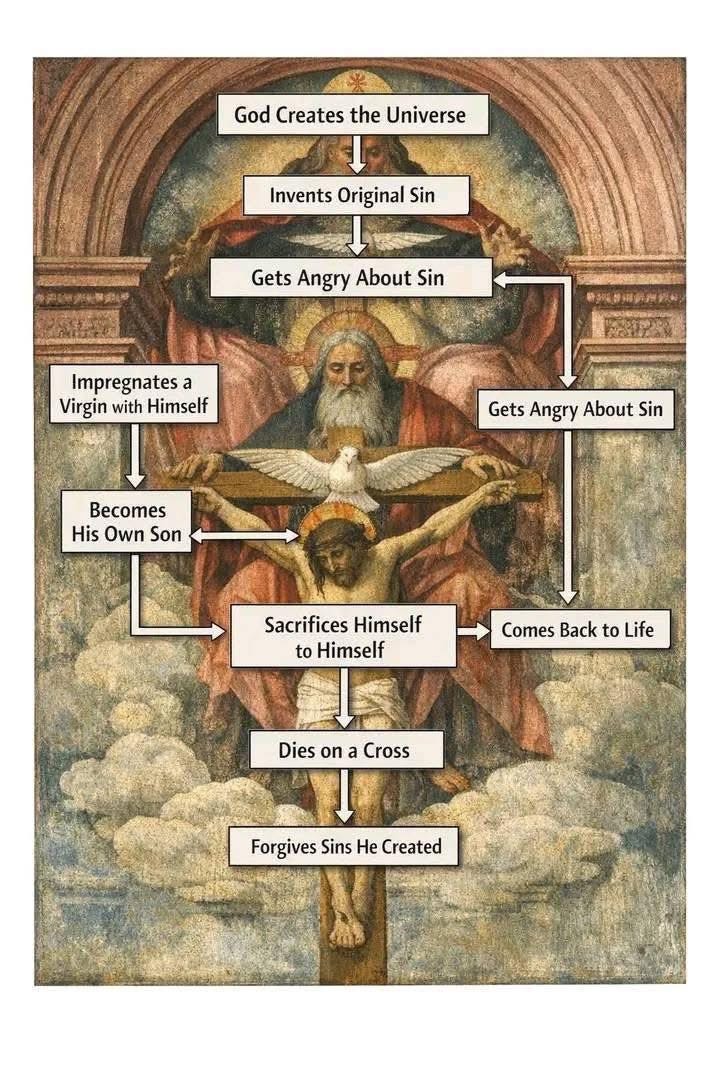
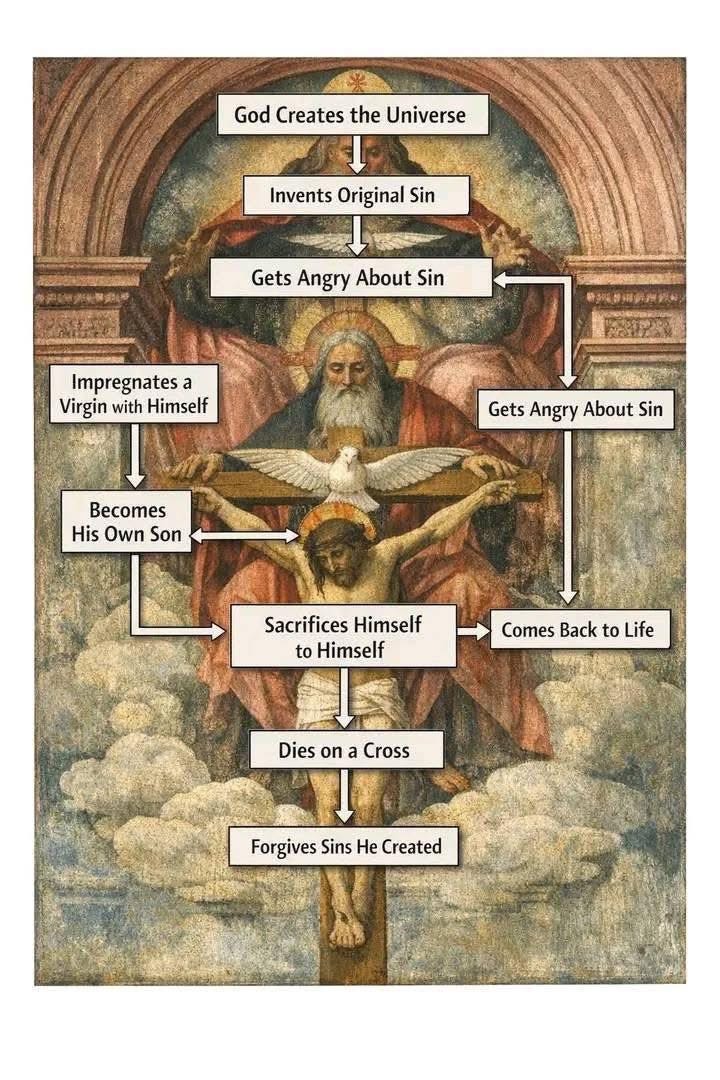
The meme says it like an accusation: God got angry about sin.
As if anger is the embarrassing part. As if a God who cares is more primitive than a God who watches the whole thing with arms crossed and a slight, knowing smile. As if indifference is the mark of sophistication.
But sit with that woman across the table for thirty seconds.
If she looked at what her husband did and felt nothing — no anger, no grief, no eruption of some necessary thing inside her chest — you would not call her enlightened. You would call her cold. You would wonder if she ever loved him at all. You would understand, for the first time, that her anger is not the opposite of her love. It is the proof of it. It is what love looks like when it runs into a wall at full speed.
The God of Scripture is angry about sin the same way.
For the wrath of God is revealed from heaven against all ungodliness and unrighteousness of men. Romans 1:18. Not a threat. A fact already declared. The verdict was published before you sat down in that chair. This is not a God who loses His temper and then regrets it. This is a God for whom holiness is not a policy but a nature — and when a holy nature encounters corruption, there is only one possible response. The same way fire does not decide to be hot.
The meme wants you to picture a small God. Fussy. Arbitrary. An HOA god, pacing the hallways of heaven, writing up violations on a clipboard, muttering about the rules he made that everyone keeps breaking. A god who is angry because he is offended. A god whose anger is finally about himself.
That is not the being in the text.
The LORD is slow to anger. Nahum 1:3.
Read that again. Slow. The God who spoke the universe into existence and holds it together with the word of His power is described by the same book as slow to anger, with His wrath moving like a whirlwind and the rocks cracking before Him. This is not a hair trigger. This is the most patient being in existence, a being who has been watching every act of cruelty, every private betrayal, every man who smiled in the third pew and lived another life in the dark — watching all of it, absorbing it, being grieved by it, and remaining slow. Remaining. Slow.
His anger is not the kind that spills over when the cup gets too full. It is the kind that waited. The kind that knows everything and waited anyway. The kind that is still waiting right now, which is a more terrifying kind of patience than any of us have vocabulary for.
And here is what that anger is aimed at.
You.
Not just the sin as some abstraction floating above you. Not a behavior in isolation. The workers of iniquity — that is the language of Psalm 5:5. Not the iniquity. The workers. Psalm 11:5 says the wicked and him that loveth violence his soul hateth. His soul. The person. Romans 9:13: Esau have I hated. Not Esau’s choices. Esau.
The “God hates sin but loves the sinner” line is not in your Bible. It is not in any Bible. It is a sentiment someone invented because they could not hold the weight of what the text actually says. It sounds merciful. It is not mercy. It is a sedative.
Because here is what it does to the cross.
If God loved you the whole time — if His wrath was never at you, only at the sin as a kind of separate entity, a parasite He was trying to remove — then what was Christ absorbing at Calvary? What exactly was being transferred? A penalty on a ledger? A fine being paid to a bureaucracy? That is not what the cross looks like. That is not why it cost what it cost. That is not why He sweat blood in the garden the night before.
The cross is extreme because what fell on Christ was extreme. The full weight of divine wrath toward a guilty man — toward the man himself, not just his record — landed on the Son. That is substitution. God did not separate you from your sin and punish the sin while handing you a pass. He counted Christ as you. The wrath that a guilty person under holy judgment deserved — that is what Christ received. In your place. As you.
That is what makes it mean anything.
Strip out the actual wrath toward the person, and you have God doing paperwork. You have a legal transaction between God and God in which nobody is actually in danger, and nobody is actually saved. That is not the gospel. That is not the text.
The father in the parable runs. Yes. But the son was dead and is alive again, lost and is found — not lost and was never really in danger, don’t worry about it. The running matters because the danger was real. The welcome matters because the distance was real. The robe and the ring matter because what the son deserved was not a robe and a ring.
God’s wrath is not aimed at an abstraction. It is aimed at what you are, at what you have done in that room, at what you have been in secret, at the man you have become. That is the honest accounting. That is what makes the rescue a rescue and not a formality.
If God was never really wrathful at you — if He loved you the whole time, no adjustment needed, then Christ did not rescue you from anything. He resolved a technicality.
That is not why He bled.
The man at the table is not going to be fine tonight.
The verdict that has been hanging over that room — the verdict that Romans says was already published, already out there in the open, visible to anyone who looked — is now also sitting in a chair with human eyes and shaking hands and four months of discovered secrets, and he cannot manage this the way he managed the courtroom in his chest.
The verdict is real.
He knows it now without being able to call it theology. His wife’s face is doing what theology could not do: it is making abstraction into flesh. It is making him feel the weight of a word he has been avoiding. Guilty. Not biologically shaped. Not chemically pressured. Not the product of a rough childhood or a high-stress job or a brain wired a certain way.
Guilty.
Something is coming. He doesn’t know what it is yet. Neither does she.
But something is coming.
Parts 3–6 of The God Who Bled are coming soon.
Part 3 takes the hardest line in the meme — “sacrificed himself to himself” — and goes straight into the logic of substitutionary atonement. Not to defend a doctrine. To explain why a guilty man sitting across from his wife is not actually the last word.
If this is landing somewhere in you, the door is $8/month. No altar call. No pressure. Just the rest of the argument, for the people who want to see where it goes.