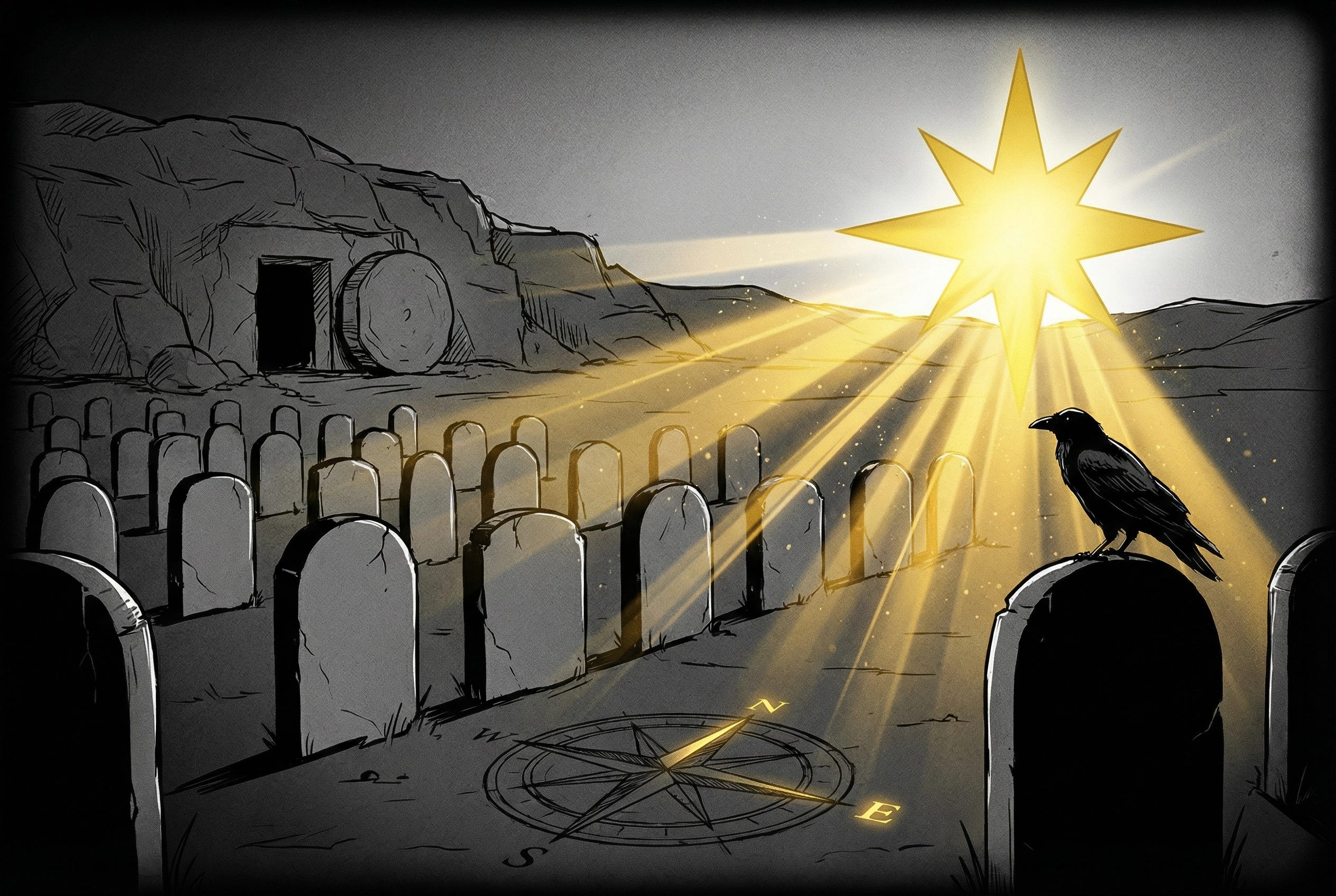
For years, I taught that Easter was a pagan word.
Ishtar. Fertility goddess. Bunnies and eggs. Babylon dressed up in church clothes. I had the Alexander Hislop book. I had the talking points. I had the righteous indignation of a man who thought he’d uncovered a conspiracy that a billion Christians were too blind to see.
I was wrong.
Not about the bunnies. Not about the eggs. I still don’t do Easter egg hunts with my kids. They know exactly where their presents come from, and it ain’t a six-foot rabbit.
But I was dead wrong about where the word Easter comes from. And when I finally sat down and traced the actual history — not internet memes, not conspiracy videos, not one book written 150 years ago — what I found wasn’t pagan at all.
It was one of the most Christ-centered words in the English language.
The Argument Everyone Knows
Acts 12:4. Herod throws Peter in prison. He’s planning to bring him out to the people “after Easter.”
Now, the Greek word there is pascha. Same word used 28 other times in the New Testament — and every other time, it’s translated Passover.
So naturally, the question comes: Why did the translators call it Easter here? Just this once?
Two camps have been arguing about this for centuries.
Camp one says it’s a mistake. A mistranslation. Should’ve been Passover. End of story.
Camp two — the camp I lived in for years — says Easter is there on purpose, but it’s referring to a pagan holiday. Herod was a pagan king. He wasn’t observing Passover. He was celebrating Ishtar. The translators knew that and used Easter to make the distinction.
Both arguments sound reasonable. Both have been repeated so many times they feel like settled truth.
But when you actually trace the word back through history, neither one holds up.
Where “Easter” Actually Comes From
Here’s what nobody told me. The word Easter has been used as a synonym for Passover in the English language for over a thousand years.
The Wessex Gospels — one of the earliest English translations of Scripture, dating back to around 990 AD — used the word Eastron, Eastran, and eventually Easter every single time the word Passover appeared.
Not as a pagan reference. As the English word for Passover. Period.
Tyndale’s Bible in 1526 — “Easter lamb.” Coverdale’s Bible in 1535 — “Easter.” The Matthews Bible. The Great Bible. Translation after translation, for centuries before the King James was ever printed, English-speaking Christians called the Passover Easter.
It wasn’t a mistake. It wasn’t pagan. It was just the English word for the thing.
The German Connection
English is a Germanic language. If you’ve ever listened to German and thought it sounded like someone speaking English with a mouthful of pretzels — you’re onto something.
Martin Luther’s German Bible, published in 1534, used the words Osterfest, Ostern, and Osterlamm — “Easter feast,” “Easter,” and “Easter lamb.”
The root word? Ost. It means east.
Spanish? The word for east is este. Same linguistic family. Same root idea.
Easter. Eastern. East.
The word doesn’t trace back to a Babylonian fertility goddess. It traces back to a compass direction.
And when you realize why that direction mattered to ancient Christians, everything clicks.
The East Star
Jesus Christ is called the bright and morning star. Revelation 22:16.
He’s called the Sun of righteousness in Malachi 4:2 — “the Sun of righteousness arise with healing in his wings.”
He’s called the day star in 2 Peter 1:19.
And what does the morning star do? What does the sun do? What does the day star do?
It rises in the east.
The old Christians — the ones who first translated Scripture into English a thousand years ago — they understood this. When they needed a word for the celebration of Christ’s resurrection, they reached for the most obvious image they had.
The star that rises from the east. The Son who conquered the grave at dawn. The light that broke the longest darkness.
Easter. The East Star.
That’s why old cemeteries point the headstones eastward. So that when the dead in Christ rise, the first thing they see is the Son coming from the eastern sky.
That’s not pagan. That’s the gospel carved into geography.
Why Acts 12:4 Is Different
Here’s the part that sealed it for me.
Twenty-nine times the Greek word pascha appears in the New Testament. Twenty-eight of those times, it’s referring to Passover celebrations that happened before Christ died on the cross. Even Hebrews 11 — it’s talking about the original Passover back in Exodus.
There is only one place in the entire New Testament where pascha refers to a Passover observance after Christ was crucified and risen.
Acts 12:4.
The only post-resurrection Passover in the New Testament. And the translators — who had been using the English word Easter interchangeably with Passover for seven hundred years — made a distinction here.
Before the cross: Passover. The lamb is coming.
After the cross: Easter. The Lamb has risen.
Same Greek word. But a different reality. The shadow became the substance. The promise became a person. And the English language, shaped by a thousand years of Christian thought, already had a word for it.
Christ our Passover is sacrificed for us (1 Corinthians 5:7). He is the Passover lamb.
And He got up.
The East Star rose.
What About Hislop?
Alexander Hislop wrote The Two Babylons in the 1850s. There’s some solid material in there about paganism creeping into Roman Catholicism. He wasn’t wrong about everything.
But his claim that Easter derives from Ishtar has a problem the size of ancient Nineveh.
He claims the word Easter is “evidently identical” in pronunciation to the way ancient Ninevites said the name Ishtar. And that this pronunciation traveled unchanged from the Middle East to the British Isles.
Think about that for one second.
We can’t even keep a word the same across a few hundred miles in the same country in the same decade. Regional dialects shift pronunciation within a single generation. But we’re supposed to believe that one word traveled from ancient Mesopotamia to medieval England and arrived unchanged?
Hislop had no recording of ancient Ninevite speech. No audio. No living witnesses. He was guessing. And a whole lot of Christians turned that guess into doctrine.
A hundred and fifty years later, that one man’s assumption has an entire generation of believers calling their brothers and sisters pagans for saying “Happy Easter.”
That’s not discernment. That’s an internet rabbit hole dressed up as theology.
So What Do We Do With This?
Say Happy Easter. Mean it.
Not because of bunnies. Not because of eggs. Not because of anything Hallmark put on a shelf.
Because a Man who was dead is alive. Because the East Star rose. Because every Sunday we gather, we’re already celebrating the resurrection — but once a year, the whole world accidentally stumbles into the Christ story whether they want to or not.
Don’t waste that by arguing about a word.
Use it. When someone says Happy Easter to you this week — at the gas station, in the grocery line, at the family dinner where half of them haven’t been to church in years — take it.
That’s an open door. Walk through it.
“Happy Easter to you, too. You know where that word comes from?”
And then tell them about the East Star.
Every Sunday is resurrection day. But this week, the whole world is listening.
Don’t correct them. Invite them.
If this Christ-centered Bible study blessed you, we have 50+ free resources at Dead Hidden Ministries — scripture guides, devotionals, and study tools for believers, families, and churches. No strings. No gimmicks. Just the Word.
Want to go deeper? Subscribe to Dead Hidden and The Biblical Man — 70,000+ believers already in the fight.
Questions? Need prayer? Communicate with us deadhidden.org
If you want to support this ministry, visit our Support Page.