Have an
answer.

A Biblical Guide to Defending Christianity

Understand the hard questions.
Examine the evidence. Explain what you believe.
ADAM AND CHRISTIE JOHNSON

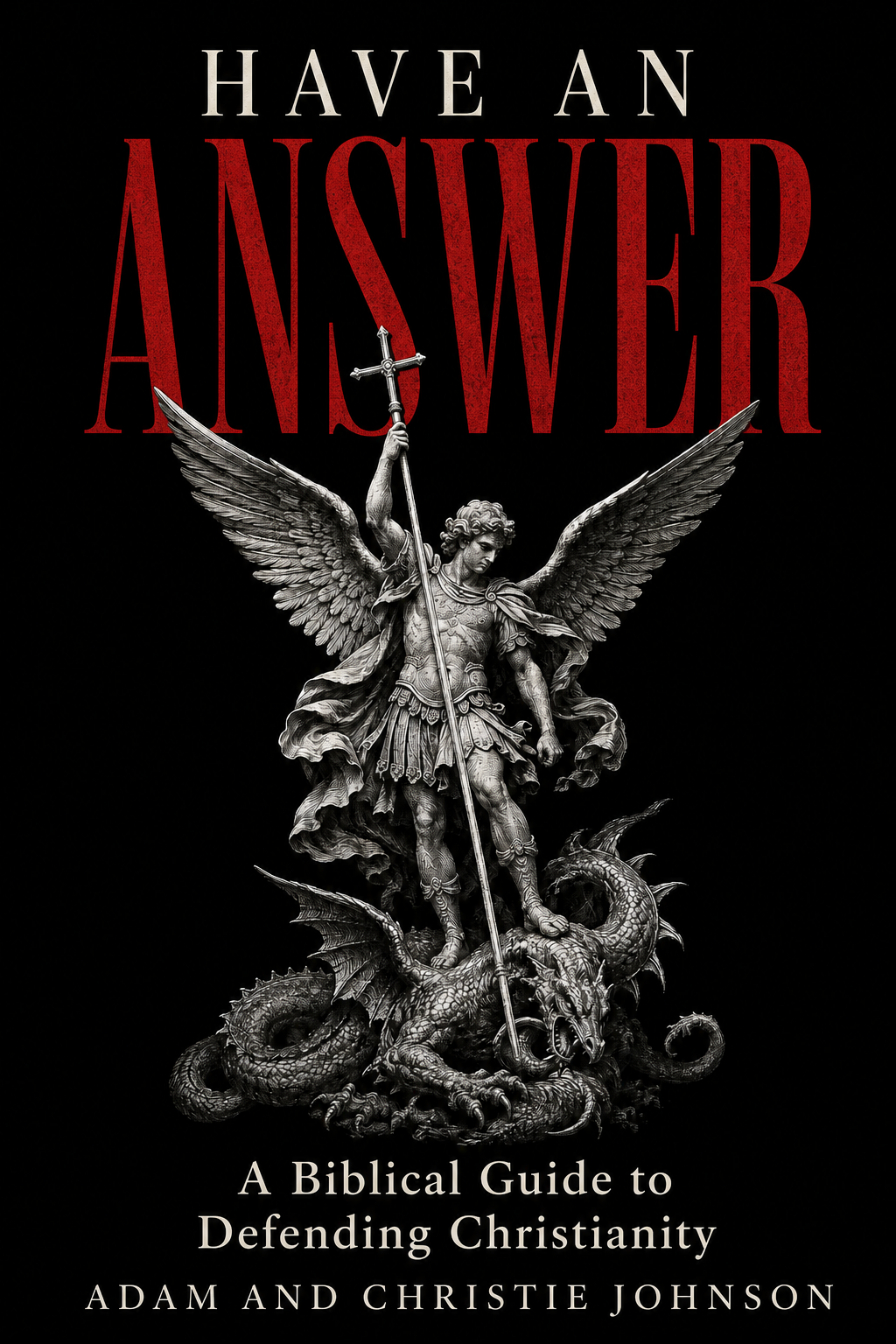
Have an Answer: A Biblical Guide to Defending Christianity, by Adam and Christie Johnson. Black cover with red lettering and a classical Christian engraving.

The questions don’t disappear
when you close the book.

Fourteen chapters. Scripture in context.
Arguments you can explain in your own words.

What you already believe

Reason, morality, and the worth of a person.

The world we have to explain

Science, the Flood, and suffering.

The Bible under examination

Manuscripts, apparent contradictions,
war, and slavery.

The claim that decides it

The resurrection, why Jesus,
and the next conversation.

Explore all 14 chapters
  1. 01The Creed Nobody Recites

    Examine the beliefs beneath disbelief, and learn to ask what someone actually believes before answering them.

  2. 02Can You Trust the Mind That Doubts?

    Consider why human reason can be trusted, what naturalistic explanations offer, and how the Christian account compares.

  3. 03Good Without God

    Explore the difference between behaving morally and explaining why a moral obligation binds us, including secular moral realism.

  4. 04What Is a Person Worth?

    Examine the biblical case for human dignity and the worth of people whose lives depend on the care of others.

  5. 05Has Science Buried God?

    Distinguish questions about the universe, the origin of life, and biological development. Examine the evidence and the limits of each argument.

  6. 06The Flood and the Fossils

    Read the Flood account alongside questions about fossils and geological time, with an honest account of differing biblical interpretations and mainstream geology.

  7. 07Where Was God?

    Work through the argument from suffering with Job and the cross in view, while recognizing what grief asks of a conversation.

  8. 08Copies of Copies

    Learn how biblical manuscripts, copying, translation, and the canon relate to the text we read today.

  9. 09When the Gospels Disagree

    Learn to distinguish an omission from a contradiction, and test proposed reconciliations against the passages themselves.

  10. 10The God Who Ordered the War

    Face the commands concerning Canaan and the moral questions they raise, including why they give no permission for modern religious violence.

  11. 11Why Didn't God Forbid Slavery?

    Read the hard provisions about biblical slavery in context, and examine both the Christian case against slavery and the use of Scripture to defend it.

  12. 12Dead Men Stay Dead

    Examine the early resurrection testimony, its historical limits, and competing explanations for the Christian claim.

  13. 13Why Jesus?

    Consider why belief in a Creator leads to further questions about Jesus, grace, the cross, and competing religious claims.

  14. 14The Question at the Kitchen Table

    Practice clear, patient conversations with a child, a skeptical friend, or a relative, including how to ask a useful follow-up question.

FROM THE INTRODUCTION

If Christianity is false, we ought to stop teaching it to our children.

Have an Answer digital guide cover

Know what
you believe.
Be ready
to explain it.

A complete digital guide for personal study, conversations with skeptical friends, and learning together at home.

The complete guide

$28.99

One purchase. Digital delivery.
Applicable tax calculated at checkout.

  • All 14 chapters
  • KJV passages with explanations
  • Discussion questions and practical exercises
  • Source notes for further study
Get the complete guide

PDF format. For personal and household use.

Before you begin

Is this a physical book?

This is a digital guide. No physical item is shipped.

Can I use it with my teenager?

The guide is designed for adult study and parent-guided learning with teens. It addresses difficult subjects, including suffering, slavery, and violence in the Bible. Parents can read ahead and choose an appropriate pace.

Do I need other books or a video course?

The complete guide works on its own. The explanations, Scripture passages, and study questions are included. Source notes point to optional further reading.

Can our household study it together?

Your purchase is for personal and household study. Contact the authors about group or classroom use.

HAVE AN ANSWER

Introduction

If Christianity is false, we ought to stop teaching it to our children.

They deserve to know what is true. A belief doesn't become true because it comforts a frightened person, keeps a family together, or has been repeated for generations. Those are reasons someone would want to believe it. The question is whether there are reasons they should.

We believe there are. We have written this book because Christianity makes claims about the world that deserve to be examined, and because the answers offered in its place deserve the same examination.

You can reject a bad answer without having a better one ready. A doctor who discovers that a medicine doesn't work is entitled to say so before finding a cure. We grant the skeptic that much. An objection to Christianity must be answered on its merits. Pointing out a difficulty in atheism doesn't make a contradiction disappear from a Christian argument.

But once the doctor tells you nothing is wrong and you need no treatment, he has made a diagnosis of his own. That claim can be questioned too.

So can the claim that the physical universe is all that exists. So can the claim that human beings possess equal worth, that some actions are wrong whether anyone approves of them, or that our minds can discover truths beyond what helps us survive. People offer reasons for believing these things. We intend to examine those reasons.

An atheist needn't hold all these views. Some reject materialism. Some defend moral truths that they believe exist independently of human opinion. Others remain undecided. The person who says he doesn't believe in God has told us one thing about himself. We still need to listen to the rest.

That is where our opening chapter begins. The unbeliever's creed is the set of beliefs a particular person affirms about reality, goodness, and knowledge. Calling those beliefs a creed doesn't refute them. It makes them available for discussion. We want to know what they are and why they should be believed.

Consider the ordinary business of calling something unfair. Suppose an employer knowingly withholds wages that a worker has earned. The employer admits what he has done. He has the money, he expects to get away with keeping it, and he prefers having it to paying the worker.

Most of us would still say he owes the wages. His preference hasn't cancelled the debt. Explaining how he acquired his selfish habits won't settle it either. We are making a claim about what he ought to do, even when doing it would cost him something he wants.

What makes that claim true? A Christian has an answer. A secular moral philosopher has answers too. Both should be willing to explain them. Calling the employer cruel gets the discussion started; it doesn't finish the work of explaining why cruelty is wrong.

The Christian will be questioned just as closely in these pages. Why does the law of Moses permit the ownership of foreign slaves? What are we to make of the commands concerning Canaan? When two biblical accounts appear to disagree, does our explanation come from the passages, or from our determination to make them fit?

These questions deserve answers that hold up when someone asks a second question. A familiar response can be repeated faithfully for years without anyone testing the reasoning beneath it. We owe our children something better than an answer that survives only until they leave the room.

Our position is plain. We believe Jesus Christ died and rose again. We believe the people who proclaimed His resurrection were making a claim about something that happened. Christianity commits itself here to a fact. Paul states the consequence of its being false in 1 Corinthians 15:14:

“And if Christ be not risen, then is our preaching vain, and your faith is also vain.”

We accept the consequence Paul names. The resurrection chapter must therefore do more than describe how much Easter means to Christians. It must examine the testimony and the explanations offered for it. Affection for a story cannot establish that it happened.

The same care belongs in the chapters about science. The origin of life and the development of living things are different questions. A gap in our knowledge is something to investigate. It gives us no permission to announce that we have proved everything we believe about God. We will distinguish the evidence from the conclusions drawn from it, including our own.

When we reach suffering, the argument will have to make room for the person asking. Someone whose child has died can ask the same question as a philosopher and need a very different response. We will examine the objection. We will also refuse to invent an explanation for a particular death that God has not given us.

Peter describes the responsibility of answering in 1 Peter 3:15:

“But sanctify the Lord God in your hearts: and be ready always to give an answer to every man that asketh you a reason of the hope that is in you with meekness and fear:”

The reason matters. So does the way we give it. Our aim is to help a reader understand the argument well enough to explain it, hear an objection without losing their temper, and continue the conversation when the prepared answer runs out.

We will defend Christianity openly. We will ask hard questions of the beliefs offered in its place. Before that examination can begin, each of us has a sentence to finish.

I believe this is true because...